Market Performance, Collecting Trends, Investment Dynamics & Global Outlook
Executive Summary
The global art market entered 2026 in a stronger position than it had occupied during the preceding two years, but its recovery has exposed an increasingly complex distinction between headline sales growth, collector participation and the underlying financial health of the art trade.
The Art Basel and UBS Art Market Report 2026, which examines completed transactions during 2025, valued the global market at approximately $59.6 billion, representing annual growth of 4%. This followed two consecutive years of contraction, although total sales remained below their 2022 peak. Public auction sales increased more rapidly than dealer revenues, reflecting renewed demand for exceptional works at the highest price levels.
Evidence from the first half of 2026 indicates that this recovery continued. Christie’s and Sotheby’s reported substantial increases in public auction sales, supported by major private collections, stronger sell-through rates and renewed bidding for established artists. Independent research from ArtTactic also identified a broad recovery across the three principal international auction houses.
Yet the market's apparent resilience conceals significant structural pressures. Rising operating costs, uneven regional demand, cautious pricing and the concentration of capital among established collectors continue to challenge galleries and auction houses.
Five findings define the present market:
The recovery is real but uneven. Global sales increased in 2025, while the high-value auction segment contributed disproportionately to growth.
Geographic concentration remains pronounced. The United States, United Kingdom and China accounted for 76% of global sales by value in 2025.
Private relationships are increasingly important. Dealer networks, discreet transactions, collection management and specialist advisory services remain essential to the market's infrastructure.
Collector behaviour is changing. The 2026 Art Basel and UBS collecting survey identifies greater independent research, increased use of AI-assisted resources and changing generational spending patterns.
Art remains a financially complex asset. Transaction costs, limited liquidity, uncertain valuations and irregular sales complicate comparisons with conventional investments.
The outlook for 2027 is therefore one of conditional opportunity rather than assured expansion. Financial resilience, authenticity, pricing discipline and the quality of relationships between collectors and market intermediaries are likely to determine which businesses and artists benefit most from renewed demand.
Reporting clarification: This report uses completed calendar-year 2025 market statistics published in 2026, together with identifiable 2026 developments available by 5 November. A verified global total for calendar-year 2026 is not yet available. All 2027 scenarios are prospective analyses, not reported outcomes.
Chapter 1 — Global Art Market Performance in 2026
A recovery defined by selectivity
The central economic development entering 2026 was the return of growth to the international art market following the contraction experienced in 2023 and 2024.
The Art Basel and UBS annual research series provides the most useful framework for assessing this movement because it combines estimates of dealer sales with public auction results and reported auction-house private sales.
2025 global sales
$59.6bn
+4% year on year
Transactions
41.5m
+2% year on year
Public auctions
$20.7bn
+9% year on year
Source: Art Basel and UBS Art Market Report 2026, reporting calendar-year 2025.
Chart 1 — Global art market sales: historical performance
Global art market sales, 2019–2025
US$ billions. Calendar-year market estimates; 2026 excluded because full-year data is unavailable.
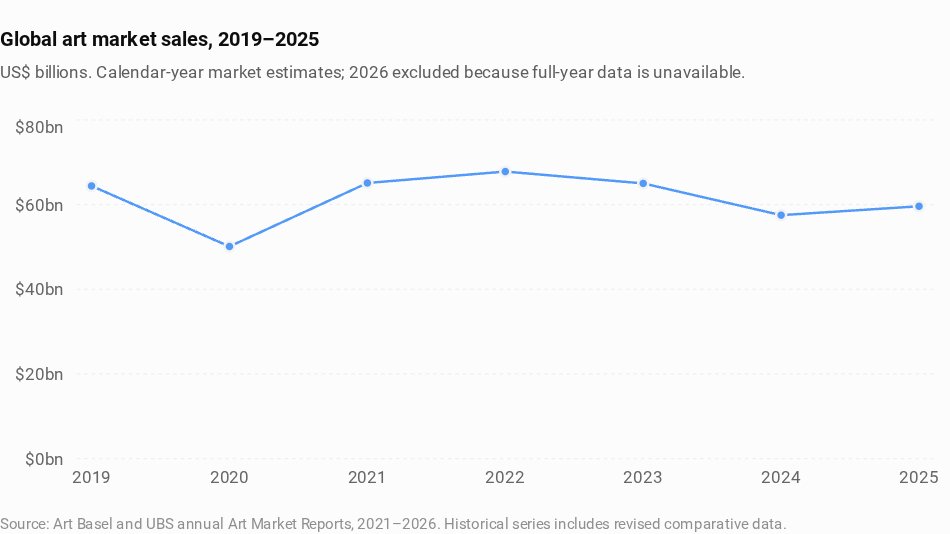
The 2019 value uses the $64.4bn historical comparator reported in the 2024 edition; the original 2020 report published a $64.1bn estimate.
The historical trajectory reveals several important characteristics.
First, the market has demonstrated considerable capacity to recover from abrupt external shocks. The decline during the pandemic was followed by substantial expansion in 2021 and a further increase in 2022. However, those gains proved vulnerable to changes in economic conditions and the availability of expensive works.
Second, recovery in aggregate transaction value does not necessarily imply comparable improvement across individual businesses. A single major estate auction can materially influence annual sales, whereas a gallery's performance depends on a more sustained sequence of acquisitions.
Third, the relationship between value and transaction volume remains crucial. In 2024, sales value declined despite an increase in the number of transactions. During 2025, both measures rose, although values increased more rapidly.
A useful statistical distinction is that dividing total sales by transactions produces an aggregate value-per-transaction indicator, not a representative artwork price. Different sales categories, transaction definitions and price distributions make the average particularly sensitive to a small number of expensive transactions.
Chart 2 — Dealer sales and auction market composition
Global sales by channel
US$ billions, 2024 and 2025. Reported and estimated sector totals; rounding differences apply.
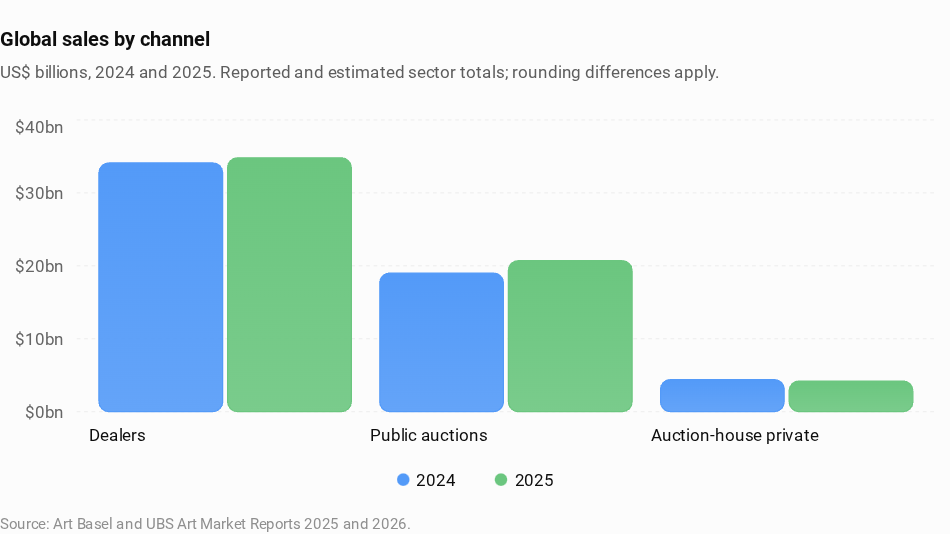
2025 private auction-house sales were reported as just under $4.2bn, displayed as 4.2 for chart readability. These private figures do not encompass all confidential transactions conducted by dealers or advisors.
Dealer sales remained the largest component of the global market, amounting to $34.8 billion in 2025. Public auctions generated $20.7 billion, while reported private sales through auction houses accounted for just under $4.2 billion.
The difference between these channels is commercially significant. Auctions provide observable transactions and public estimates, allowing relatively rapid shifts in sentiment to become visible. Galleries operate through private negotiation, repeat relationships and individual pricing strategies, making their market less transparent but potentially less exposed to public failures.
Dealer operating costs reportedly increased by an average of 5% in 2025, exceeding their aggregate sales growth of 2%. Thus, higher revenue did not automatically translate into stronger profitability.
The economic forces behind demand
The market remains sensitive to interest rates, financial wealth, currency movements, geopolitical tensions and the cost of transferring artworks internationally.
High-net-worth collectors frequently make acquisitions using accumulated wealth rather than ordinary consumer income. Their willingness to purchase may therefore be influenced by financial market performance, business liquidity and perceptions of long-term wealth preservation.
However, artistic importance, emotional attachment, institutional interest and scarcity also influence purchasing decisions. The art market cannot be understood solely through conventional consumer-demand models.
This combination helps explain why transactions involving exceptional works can strengthen even while smaller galleries face persistent financial pressure.
Chapter 2 — The World's Leading Art Markets
The geography of wealth and cultural influence
The international art market remains geographically concentrated, even as new collecting centres gain institutional prominence.
The United States continues to dominate aggregate sales, supported by its concentration of private wealth, major auction houses, established galleries and museum collections. London retains its importance as an international trading centre, while China occupies a distinct position through the scale of its domestic auction market and Hong Kong's international connections.
France has strengthened its position within continental Europe, benefiting from Paris's growing prominence as a destination for major galleries, auctions and international art events.
Chart 3 — Leading art markets by global market share
Share of global art market sales, 2025
Percentage of worldwide sales value. Dealer and auction activity combined.
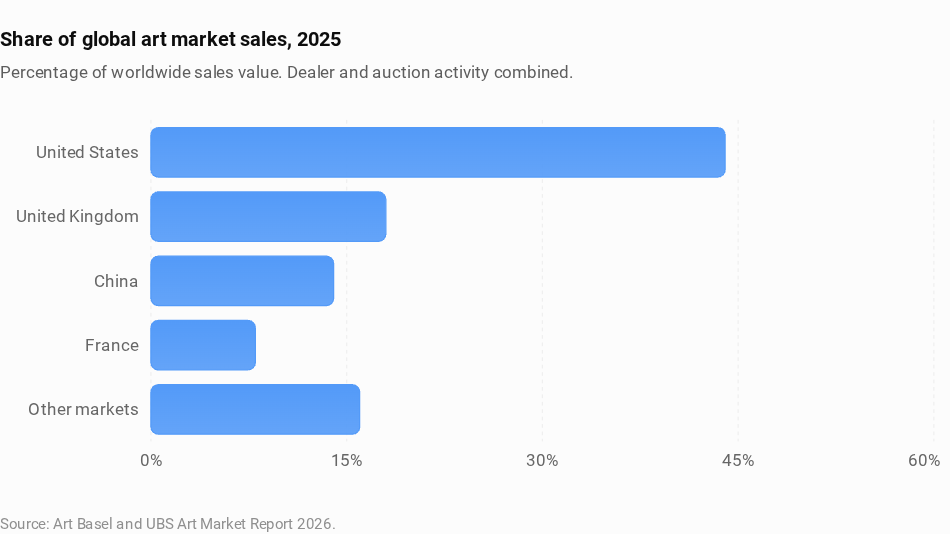
Shares are rounded estimates. China includes Mainland China and Hong Kong within the report's market classification. The residual category is calculated from the published leading-market shares.
The United States: the centre of the high-value market
American art market sales reached approximately $26 billion in 2025, representing growth of 5%.
New York remains particularly influential in the market for internationally recognised modern, post-war and contemporary artists. Its commercial infrastructure combines auction houses, established galleries, private advisors and major collecting institutions.
The concentration of ultra-high-value transactions reinforces this position. In 2025, all ten of the world's highest-priced auction lots were sold in New York.
Nevertheless, the American market is not insulated from external pressures. Uncertainty surrounding tariffs, international shipping, insurance and taxation can affect the timing and structure of acquisitions.
The commercial importance of New York should therefore be distinguished from the geographical origin of buyers, sellers or artists. International collections often enter the American auction market because New York offers established networks of potential bidders and specialist expertise.
The United Kingdom: international influence beyond domestic demand
The United Kingdom recorded art market sales of approximately $10.5 billion in 2025, a modest increase on the preceding year.
London retains an internationally competitive position through its auction infrastructure, galleries, advisory sector and international collecting networks. Its market also benefits from the presence of major cultural institutions and an established ecosystem of art-related legal, insurance and logistics services.
However, Britain's trading environment continues to face challenges arising from international competition, cross-border administration and the cost of conducting transactions.
The central strategic question is whether London can preserve its international reach while remaining commercially attractive to consignors whose artworks could be offered in New York, Paris, Hong Kong or another centre.
China: substantial scale, uneven performance
China remained the world's third-largest art market in 2025, with sales of approximately $8.5 billion.
Growth was limited, reflecting economic uncertainty and different conditions between Mainland China and Hong Kong. Mainland auction activity showed improvement, while Hong Kong's internationally oriented market faced greater pressure.
It is important not to treat these markets as interchangeable. Mainland China has distinct collecting traditions, auction categories, regulatory considerations and domestic commercial structures. Hong Kong serves as a more internationally connected centre for the circulation of modern, contemporary and Asian art.
Changes in China's real estate sector, household wealth expectations and broader economic confidence remain significant considerations.
Nevertheless, China's established collecting culture and institutional development make it difficult to interpret a period of slower trading as evidence of diminishing long-term importance.
France and the continental European market
France generated approximately $4.5 billion in art market sales during 2025, an increase of 9%.
Paris's institutional landscape and growing international commercial visibility have strengthened its competitive position. At the same time, France's growth reflects activity in both auctions and galleries rather than a single isolated segment.
Other European markets produced mixed results. Switzerland and Austria recorded growth of 13%, Spain increased by 6%, while Germany declined by 10% and Italy by 2%.
Chart 4 — Geographic developments across selected markets
Annual change in national art market sales, 2025
Percentage change from 2024. These are total-market estimates, not public-auction-only comparisons.
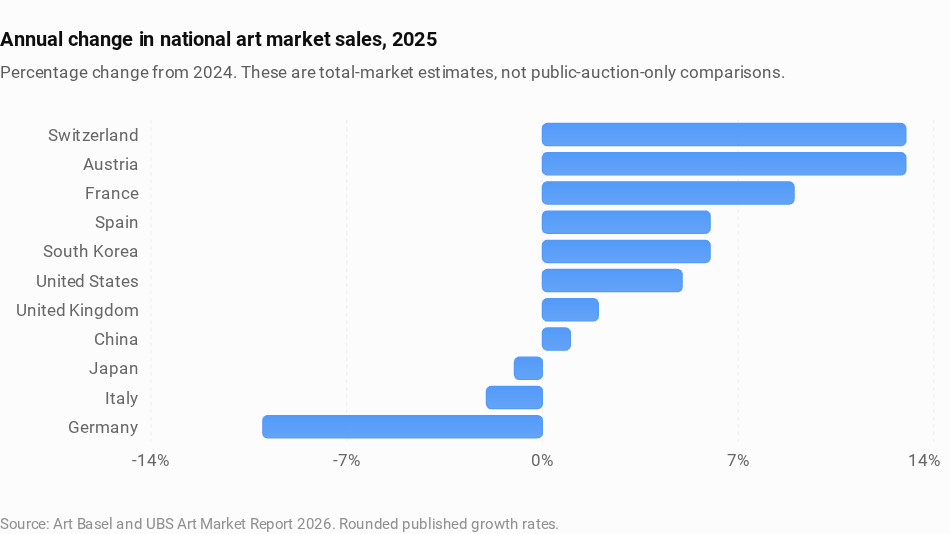
China's increase was reported as just over 1%; 1% is shown as a rounded chart value. Growth rates measure changes from different national bases and should not be interpreted as equivalent additions to global sales.
The Middle East: institutional development and emerging commercial infrastructure
The Middle East is becoming increasingly important within the international cultural economy, although its commercial development must be assessed independently of the established markets.
The inaugural Art Basel Qatar 2026 took place in Doha in February 2026, bringing together 87 participating galleries from 31 countries and territories.
Its significance extends beyond immediate transactions. The fair represents an investment in cultural infrastructure, international relationships and the visibility of artists from the Middle East, North Africa and South Asia.
The United Arab Emirates and Saudi Arabia also form part of this broader regional development, with cultural institutions, private collecting and ambitious exhibition programmes supporting artistic engagement.
However, cultural investment should not automatically be treated as evidence of equivalent growth in secondary-market liquidity. The commercial maturity of a collecting centre depends on sustained purchasing activity, specialist expertise, resale opportunities and confidence in the surrounding legal and financial infrastructure.
The region's long-term opportunity lies in developing a collecting ecosystem rather than simply competing to host international sales.
Chapter 3 — Auction Houses and the High-End Market
The resurgence of international auctions
Public auctions provided some of the strongest evidence of market recovery during the first half of 2026.
Christie's reported auction sales of approximately $3.5 billion for January through June, up 71% year on year. Sotheby's reported approximately $3.4 billion, up 59%. Phillips reported approximately $507 million for its spring selling season, representing growth of 60%.
These figures were published by the auction houses and reported in specialist trade journalism. They demonstrate renewed market activity, but their different category and reporting definitions require caution when making comparisons.
For a more consistent comparison, ArtTactic's independently compiled first-half auction dataset is used below.
Chart 5 — Major auction houses: comparative performance
Auction sales at the three leading houses, H1 2026
US$ billions, approximately. Independently compiled ArtTactic figures; excludes motor cars and private sales.
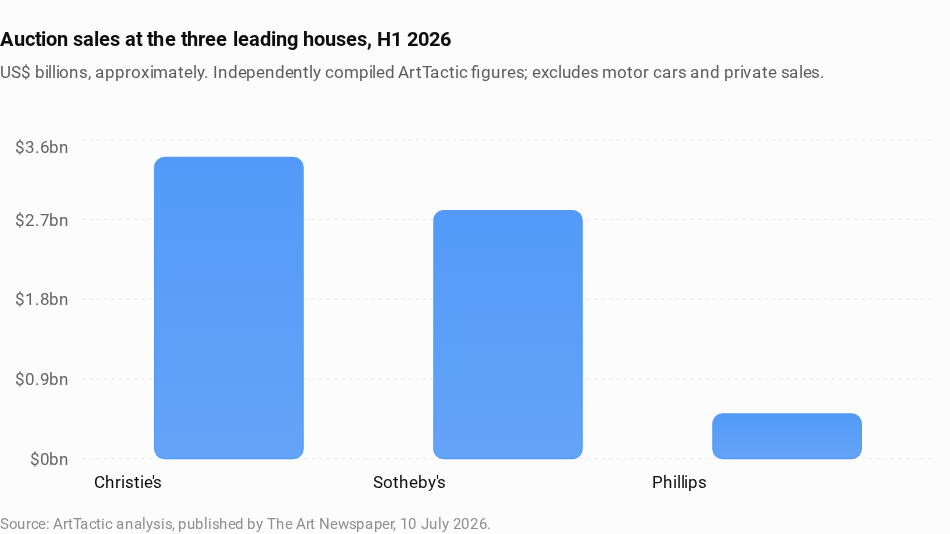
ArtTactic's dataset differs from the auction houses' subsequently reported corporate totals because of coverage and classification differences. The figures must not be mixed without reconciliation.
The ArtTactic research estimated combined auction sales at approximately $6.8 billion during the first half of 2026, an increase of 70% on the corresponding period of 2025.
Although major collections contributed substantially, the research also identified improving activity outside the most expensive evening auctions.
This is an important distinction. A genuinely broad recovery requires more than the successful sale of a small number of exceptional objects. It requires active bidding, acceptable reserves, reliable sell-through and repeat participation across multiple price levels.
Trophy works and the power of provenance
Major private collections continued to provide some of the most commercially influential sales of 2026.
At Christie's New York, Jackson Pollock's Number 7A (1948) sold for $181.2 million in May. Constantin Brancusi's Danaïde achieved $107.6 million, while Mark Rothko's No. 15 (Two Greens and Red Stripe) realised $98.4 million.
The S. I. Newhouse collection generated $630.8 million at Christie's in May, demonstrating the substantial commercial influence of prestigious single-owner collections.
Such results illustrate how rarity, provenance and the identity of a collection can become central to price formation.
Buyers are not necessarily purchasing only the artistic object. They may also be acquiring a recognised historical position, distinguished ownership history and the prospect of future institutional relevance.
Yet these exceptional transactions should not be interpreted as representative of the performance of all artworks by the same artist, much less the wider contemporary market.
Chart 6 — Auction performance by price segment
Change in global fine art auction sales by price tier, 2025
Year-on-year change in sales value. The upper tiers overlap and must not be added together.

The $10m-plus category is contained within the $1m-plus category. Published changes relate to the 2025 calendar year, not first-half 2026.
The chart demonstrates the concentration of the 2025 recovery. Sales above $10 million grew substantially faster than activity at lower price points.
For the most expensive artworks, liquidity can remain strong when provenance, quality and buyer competition align. For less established works, price expectations may be more difficult to reconcile with market demand.
Guarantees, reserves and managed risk
Auction guarantees have become an essential mechanism for securing important consignments.
A guarantee provides a seller with an agreed minimum financial outcome, potentially supplied by the auction house or a third party. This arrangement can encourage collectors to offer valuable works, but it may also transfer financial exposure to the guarantor.
Third-party arrangements can reduce the auction house's direct risk while providing investors or collectors with an economic interest in the transaction.
Reserves serve a related but different purpose. They establish the minimum acceptable selling price and can protect consignors from outcomes below expectations.
These mechanisms help explain why published estimates and hammer prices do not reveal the full economic structure of an auction.
The same principle applies to reported sell-through rates. A high proportion of successful lots may reflect strong demand, careful estimates, attractive guarantees, selective consignments or some combination of these factors.
Private sales: competition beyond the saleroom
Private transactions are increasingly central to the strategic positioning of major auction houses.
The apparent contradiction is that global auction-house private sales declined in 2025, while the leading houses reported stronger private activity during the first half of 2026.
Christie's reported more than $1 billion in private sales during H1 2026, while Sotheby's reported $826 million.
These developments suggest renewed competition for clients seeking discretion and flexible transaction structures.
Private sales can offer confidentiality, negotiated timing, controlled exposure and greater flexibility over terms. They may be particularly attractive when a seller wishes to avoid the public implications of an unsuccessful auction.
For auction houses, this creates opportunities for recurring advisory relationships, financing services and transactions outside the traditional auction calendar.
However, the expansion of private activity also reduces the proportion of transactions whose prices are publicly observable, complicating independent market analysis.
Chapter 4 — Contemporary Art and Collector Behaviour
A market increasingly differentiated by reputation
The contemporary art sector continues to exhibit a pronounced distinction between established artists with substantial exhibition histories and emerging artists whose secondary markets remain underdeveloped.
The 2025 auction data showed that combined Postwar and Contemporary sales declined by 2% to approximately $4.5 billion. Modern art rose 9% to $2.4 billion, while Impressionist and Post-Impressionist sales expanded 47% to $1.8 billion.
These figures indicate stronger demand for certain historically established categories, although individual collection sales can materially influence annual changes.
For contemporary artists, institutional recognition can influence demand by strengthening confidence in an artist's contribution to art history. Museum exhibitions, scholarly publications and inclusion in important collections may reinforce an artist's reputation over time.
Institutional recognition does not, however, guarantee financial appreciation. Exhibition activity and commercial liquidity are distinct measures of success.
Generational change and the new collector
The Art Basel and UBS Survey of Global Collecting 2026 provides particularly valuable evidence about changing collector behaviour.
Conducted among 3,100 high-net-worth collectors across ten markets, it found that Generation Z respondents reported substantially higher average fine-art expenditure than older generations surveyed.
In 2025, average fine-art spending across the survey sample was $124,265, while Generation Z respondents averaged $347,460.
These findings are notable but should not be generalised to an entire generation. The sample represents high-net-worth collectors rather than the broader population, and average expenditure can be influenced by exceptionally wealthy respondents.
Chart 7 — Collector research and purchasing behaviour
Selected behaviours of high-net-worth art collectors, 2026
Percentage of survey respondents. Multiple behaviours can apply to the same collector; values are not additive.
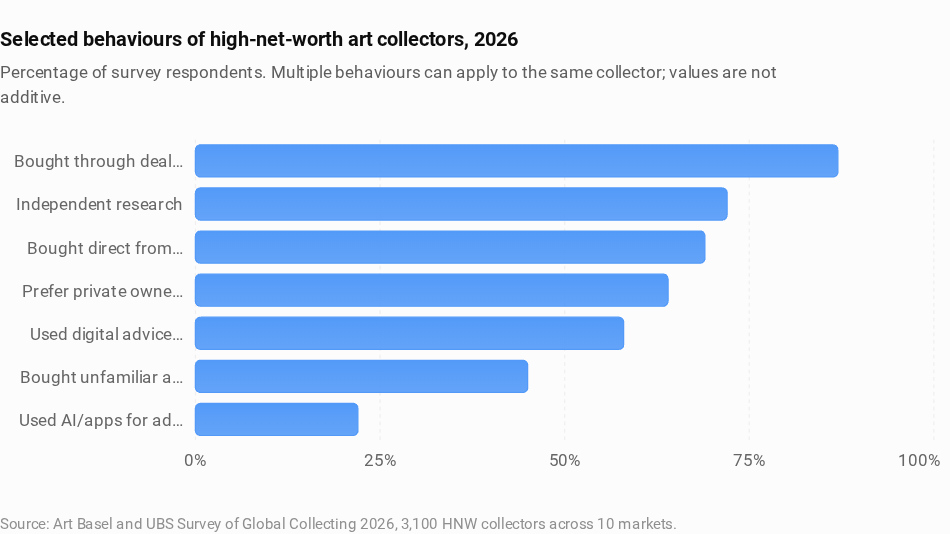
Dealer and artist-direct purchasing refer to reported purchasing activity over the relevant survey periods; independent research, privacy and digital advice represent separate measures. The 2026 survey incorporates responses on 2025 and first-half 2026 activity.
Several implications emerge.
Collectors increasingly expect access to information and evidence before purchasing. Artist documentation, provenance, exhibition records and pricing explanations are therefore becoming more important commercial tools.
At the same time, direct relationships with artists are becoming more significant. Such relationships can expand access and reduce dependence on traditional intermediaries, although established galleries continue to provide essential services in career development, market positioning and collection stewardship.
The survey also identified growing interest in digital research tools, including AI. However, the ability to discover an artist or analyse comparable prices does not eliminate the need for independent authentication and specialist judgement.
The renewed importance of art fairs
Art fairs remain central to international gallery sales.
The Art Basel and UBS market research found that art fairs accounted for 35% of dealer turnover in 2025, their highest share since 2022.
For galleries, fairs provide concentrated access to existing collectors, new clients, institutional representatives and international networks.
Yet participation is expensive. Exhibition costs, transport, insurance, accommodation and staffing create financial risks that can be difficult to absorb when sales are uncertain.
The strategic challenge is increasingly one of selectivity. Galleries must evaluate fairs not only by immediate revenue but also by the quality of relationships, long-term collector development and institutional opportunities they generate.
Chapter 5 — Art Investment and Financial Performance
Understanding art as an alternative asset
The financial appeal of art rests partly on its scarcity, cultural importance and potential for long-term value appreciation.
Unlike listed securities, however, artworks are heterogeneous assets whose prices depend on characteristics that cannot be standardised easily.
Two paintings by the same artist may have significantly different values because of condition, provenance, period, subject matter, dimensions or exhibition history.
This complicates the construction of investment benchmarks and limits the usefulness of simple comparisons between auction prices and traditional asset classes.
Liquidity and transaction costs
Art is generally less liquid than publicly traded financial assets.
A collector seeking to sell may need to identify an appropriate intermediary, obtain an updated valuation, negotiate reserves, arrange shipping and wait for a suitable auction or private buyer.
Financial returns must also be assessed after commissions, insurance, conservation, storage, taxation and other expenses.
Auction records ordinarily describe successful transactions. They do not reveal the full population of unsuccessful consignments or privately held works that cannot attract acceptable offers.
Consequently, an increase in an artist's auction price index should not be interpreted as an equivalent increase in an investor's realised return.
The limitations of art price indices
Art market indices face several methodological challenges.
Repeat-sales indices rely on artworks that have traded at least twice, potentially excluding objects that remain permanently in private or institutional ownership.
Hedonic indices attempt to adjust for differences between artworks through statistical modelling, but cannot fully capture subjective distinctions in quality, historical importance or desirability.
Both approaches may suffer from selection bias because artworks brought to market are not a random sample of all existing holdings.
A period of rising auction prices may therefore reflect changes in the composition of works sold rather than broad appreciation across the entire market.
Family offices and the financialisation of collecting
For family offices and wealthy collectors, artworks may form part of broader wealth-planning discussions involving succession, estate management, philanthropy and secured lending.
The 2026 Art Basel and UBS collector survey reported that 19% of respondents intended to use artworks as loan collateral over the following twelve months. This indicates interest in the financial utility of collections, although it does not establish that borrowing will occur or that art-backed lending is suitable for every collector.
Lending introduces additional risks, including collateral revaluation, contractual restrictions and potential forced sales.
A disciplined approach to art ownership should therefore distinguish cultural objectives from financial expectations.
The central principle is that art can possess enduring cultural value without generating predictable investment returns.
Chapter 6 — Outlook for 2027
Recovery, consolidation or renewed volatility?
The outlook for 2027 depends on whether the improved auction results observed during 2026 can develop into sustained demand across the broader market.
The International Monetary Fund's October 2026 World Economic Outlook projected global economic growth of 3.4% in 2027, compared with 3.1% in 2026. However, the IMF also identified continuing risks involving geopolitical conflict, trade tensions, financial vulnerabilities and the sustainability of technology-related investment expectations.
For the art market, these economic conditions could influence the availability of discretionary capital, confidence among wealthy collectors and the willingness of sellers to release important works.
Nevertheless, a stronger global economy would not necessarily produce equivalent growth in art sales. The composition of available artworks, the concentration of wealth and the behaviour of a relatively small population of high-value buyers will remain decisive.
Three scenarios for 2027
The following scenarios are qualitative assessments developed by ART MARKET EXPERTS. They are not statistical forecasts and do not assign unsupported probabilities or market-size estimates.
Scenario A: Sustained recovery
Upside
A supportive economic environment, improving financial confidence and increased availability of important collections encourage stronger activity across auction and dealer markets.
Potential implications: Higher sell-through rates, improved gallery turnover, stronger international participation and more consistent demand beyond trophy works.
Scenario B: Selective stabilisation
Intermediate
Demand remains concentrated in established artists and exceptional works, while emerging and mid-market segments recover unevenly.
Potential implications: Continued strength in private transactions, cautious pricing, selective consignments and pressure on smaller galleries' operating margins.
Scenario C: Renewed market pressure
Downside
Financial volatility, geopolitical disruption or weaker collector confidence reduce discretionary acquisitions and discourage sellers from bringing important artworks to market.
Potential implications: Lower auction turnover, increased withdrawals or unsold lots, longer private-sale negotiations and further gallery consolidation.
Structural developments to monitor
Several themes are likely to influence the direction of the market irrespective of the broader economic scenario.
Private transactions and advisory relationships.
Auction houses and international dealers are likely to continue developing flexible, relationship-driven services, particularly for collectors seeking discretion, financing and collection management.
Emerging geographic centres.
Cultural investment in the Middle East and other developing collecting regions could create new opportunities, although sustainable commercial growth will depend on institutional depth and consistent collector participation.
Gallery business models.
International fairs will remain important, but rising costs may encourage greater selectivity, collaborative projects, regional exhibitions and more focused collector engagement.
Technology and transparency.
Digital documentation, provenance research and AI-assisted discovery could improve access to information. Their commercial significance will depend on accuracy, privacy protections and the ability to distinguish reliable expertise from automated speculation.
Succession and generational transition.
Inherited collections, changing collecting preferences and intergenerational wealth transfers could influence the supply of important artworks and the composition of future demand.
Conclusion: A market confronting its own structure
The global art market entered 2026 with renewed commercial momentum. Major auction results, the recovery of public sales and growing engagement among younger high-net-worth collectors demonstrate that demand for culturally significant objects remains substantial.
Yet the market's future cannot be judged solely by spectacular prices.
Its long-term development will depend on whether confidence expands beyond exceptional consignments, whether galleries can operate profitably, and whether collectors can acquire artworks with greater access to dependable information.
The emergence of new collecting centres, the increasing importance of private transactions and the growing sophistication of collector research suggest an industry undergoing meaningful structural change.
For 2027, the most credible outlook is not one of unconditional expansion, but of continued differentiation.
Businesses that combine specialist expertise, financial discipline, credible documentation and enduring collector relationships may be better positioned to navigate an uncertain environment.
The defining question is whether the recovery visible at the top of the market can develop into a more balanced and sustainable commercial foundation for the international art ecosystem.
Research methodology and data limitations
This report was prepared using publicly available research and market disclosures accessible by 5 November 2026.
The principal global market estimates are taken from the annual Art Basel and UBS reports authored by Arts Economics. These figures combine public auction information with estimates and surveys of less transparent dealer activity. They are market estimates rather than a complete census of every transaction.
First-half 2026 auction statistics use separately identified corporate disclosures and independent research. Differences in reporting coverage, commission treatment, product categories and inclusion of private sales limit direct comparisons.
Collector survey findings reflect the characteristics of respondents and should not be interpreted as representative of all collectors worldwide.
Historical art market values are shown in nominal US dollars, without adjustment for inflation. Figures may also be revised between successive research editions.
The report contains seven evidence-based charts. An eighth numerical forecast chart has deliberately been replaced by qualitative scenarios because a sufficiently substantiated 2027 market forecast is not available.