For much of the twentieth century, the white-walled gallery became the dominant architectural expression of the commercial art world. Its neutral surfaces, controlled lighting and carefully arranged artworks promised an environment in which artistic objects could be encountered without distraction. The white cube represented more than a design convention. It established a particular relationship between art, commerce and cultural authority, presenting the gallery as a space where aesthetic judgement could appear independent of the market transactions supporting it.
Today, that model is being challenged by a growing diversity of exhibition environments. Industrial warehouses, private residences, historic buildings, landscaped estates and technologically immersive spaces are changing how audiences encounter contemporary art. Some galleries are abandoning conventional premises in favour of temporary exhibitions and intimate collector experiences. Others are investing in ambitious architectural destinations that combine exhibitions with hospitality, education and public programming.
Technology is extending these possibilities further. Interactive installations, projection-based environments and digitally responsive artworks invite visitors to participate in experiences that cannot be understood through the traditional relationship between an isolated object and a stationary observer.
Yet the transformation raises questions about the economics of exhibiting art. Does an immersive environment create stronger collector engagement, or does it risk reducing artistic experience to entertainment? Can unconventional spaces generate sustainable sales, and how do they compare with the established infrastructure of commercial galleries?
The apparent decline of the white cube is not simply an architectural development. It reflects a broader reconsideration of what galleries are expected to provide, how cultural value is communicated and where the boundaries between artistic experience and commercial activity should be drawn.
The White Cube and Its Changing Authority
The white cube emerged as an influential exhibition convention during the development of modernism, when galleries increasingly sought to present artworks within visually restrained environments.
White walls, minimal furnishings and carefully controlled spatial arrangements encouraged viewers to concentrate on the formal qualities of individual works.
The model also developed a powerful institutional symbolism. An artwork placed within a pristine gallery appeared to occupy a privileged cultural setting, removed from the disorder of everyday life.
In his influential essays Inside the White Cube, first published in Artforum in 1976, Brian O'Doherty examined how gallery architecture shaped the interpretation of modern art and reinforced particular forms of institutional authority.
His argument remains relevant because supposedly neutral exhibition spaces are never entirely independent of the values and interests that produce them.
The white cube can provide excellent conditions for examining painting, sculpture and photography. It allows works to be compared, studied and experienced with relatively few visual distractions.
However, it can also establish a formal relationship between art and audiences that some visitors find intimidating or inaccessible.
For artists working with environmental installation, participatory practice or technologies that transform surrounding space, the conventional gallery can become a limitation rather than an advantage.
The growing diversity of artistic media has therefore encouraged a parallel diversification of exhibition architecture.
Why Galleries Are Rethinking Their Physical Spaces
The pressure to reconsider conventional gallery premises is not exclusively cultural. It is also economic.
Maintaining commercial spaces in major art capitals involves substantial fixed costs, including rent, staffing, insurance, utilities and exhibition production.
The Art Basel and UBS Art Market Report 2026, analysing 2025 performance, estimated that global dealer sales increased by 2 per cent to $34.8 billion.
Yet average operating costs rose by approximately 5 per cent, outpacing sales growth. Thirty-eight per cent of dealers reported declining profitability.
The financial imbalance encourages experimentation with less conventional operating structures.
Some galleries are sharing premises, organising temporary exhibitions or developing appointment-based models that reduce the costs associated with maintaining permanent retail-style locations.
The same report documented shared-space initiatives in New York, including collaborations involving JDJ, Deanna Evans Projects and Chozick Family Art Gallery, as well as Marinaro and Candice Madey.
Such arrangements demonstrate how galleries can preserve physical exhibitions while sharing operational costs and expanding their professional networks.
The implications extend beyond financial efficiency.
Temporary or shared spaces can encourage more flexible programming, allowing exhibitions to respond to particular artworks rather than requiring every presentation to conform to the same architectural formula.
The result is not necessarily the disappearance of galleries, but the gradual separation of gallery activity from a single permanent location.
Hauser & Wirth Somerset: The Gallery as a Cultural Destination
One of the most established examples of the expanded gallery model is Hauser & Wirth Somerset, which opened in 2014 on the restored Durslade Farm estate near Bruton, England.
Rather than recreating a conventional urban gallery, the project combines exhibition spaces with landscaped gardens, architecture, education, hospitality and community activities.
The former agricultural buildings were restored and adapted to accommodate contemporary exhibitions, while Piet Oudolf's designed landscape introduced another dimension to the experience of visiting.
Over its first decade, the centre welcomed more than one million visitors, according to Hauser & Wirth.
The significance of this model lies in the way it repositions the gallery within a broader cultural environment.
Visitors may encounter artworks, explore the landscape, attend educational programmes or participate in events without approaching the destination primarily as potential purchasers.
Commercial activity remains part of the gallery's wider business, but it is embedded within an experience that extends beyond the conventional sales exhibition.
This approach can strengthen relationships between galleries, artists and audiences while creating opportunities for public engagement.
It also demonstrates how architecture and landscape can contribute to an institution's identity without displacing artistic content.
Nevertheless, such destinations require substantial resources and cannot easily be reproduced by smaller galleries.
The Somerset model is therefore best understood as one possible evolution of the commercial gallery rather than a universally applicable alternative.
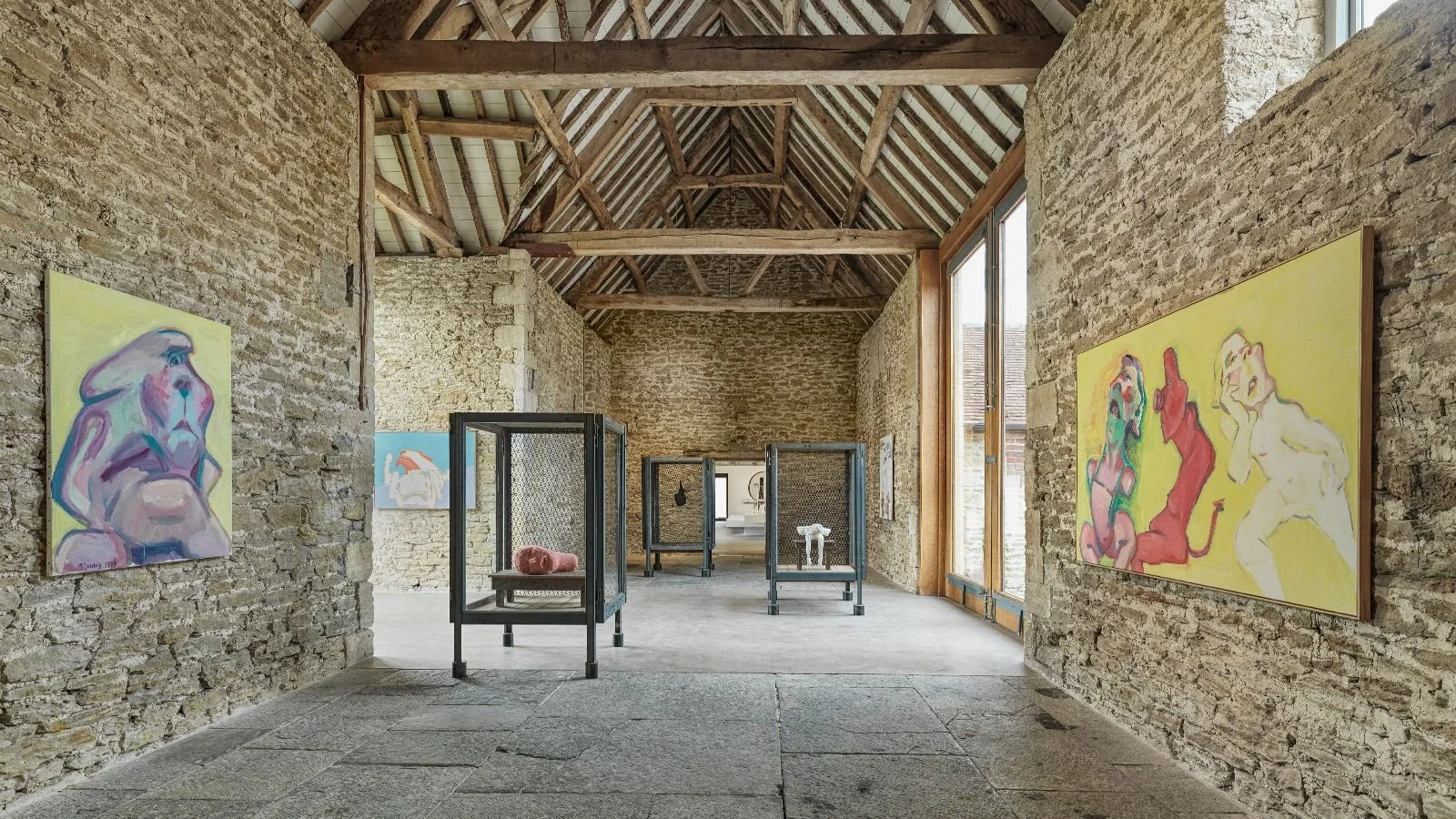
Contemporary art displayed within the historic architecture of Hauser & Wirth Somerset, demonstrating the transformation of unconventional buildings into cultural destinations.
Immersive Art and the Experience Economy
At the opposite end of the exhibition spectrum, immersive art venues are developing business models that rely on audiences purchasing access to an experience rather than acquiring a physical artwork.
Superblue Miami illustrates this distinction.
Located in the Allapattah neighbourhood, the venue offers more than 50,000 square feet of immersive artistic experiences, presenting work by internationally recognised artists and collectives.
Its programme includes environments associated with James Turrell, Es Devlin, Rafael Lozano-Hemmer and teamLab.
Visitors encounter installations that engage light, movement, reflection, digital imagery and physical participation.
The emphasis differs from that of conventional galleries. Instead of examining artworks primarily as discrete objects available for acquisition, audiences experience installations that unfold through space and time.
Ticketing provides a visible component of the commercial structure, although the detailed economics of individual artistic commissions and production agreements are not generally disclosed.
This distinction matters when evaluating the growth of immersive art.
Ticketed exhibition revenue is not equivalent to dealer sales, and audience attendance should not be interpreted as evidence of demand for collectible artworks.
The experience economy creates commercial opportunities for artists and producers, but those opportunities operate through different financial mechanisms.
In some cases, the principal economic asset is not a unique object but the ability to present, maintain and potentially adapt an experience across venues.
Such arrangements introduce new questions about intellectual property, production costs, technological maintenance and the distribution of revenue between artists and commercial operators.
teamLab and the Architecture of Participation
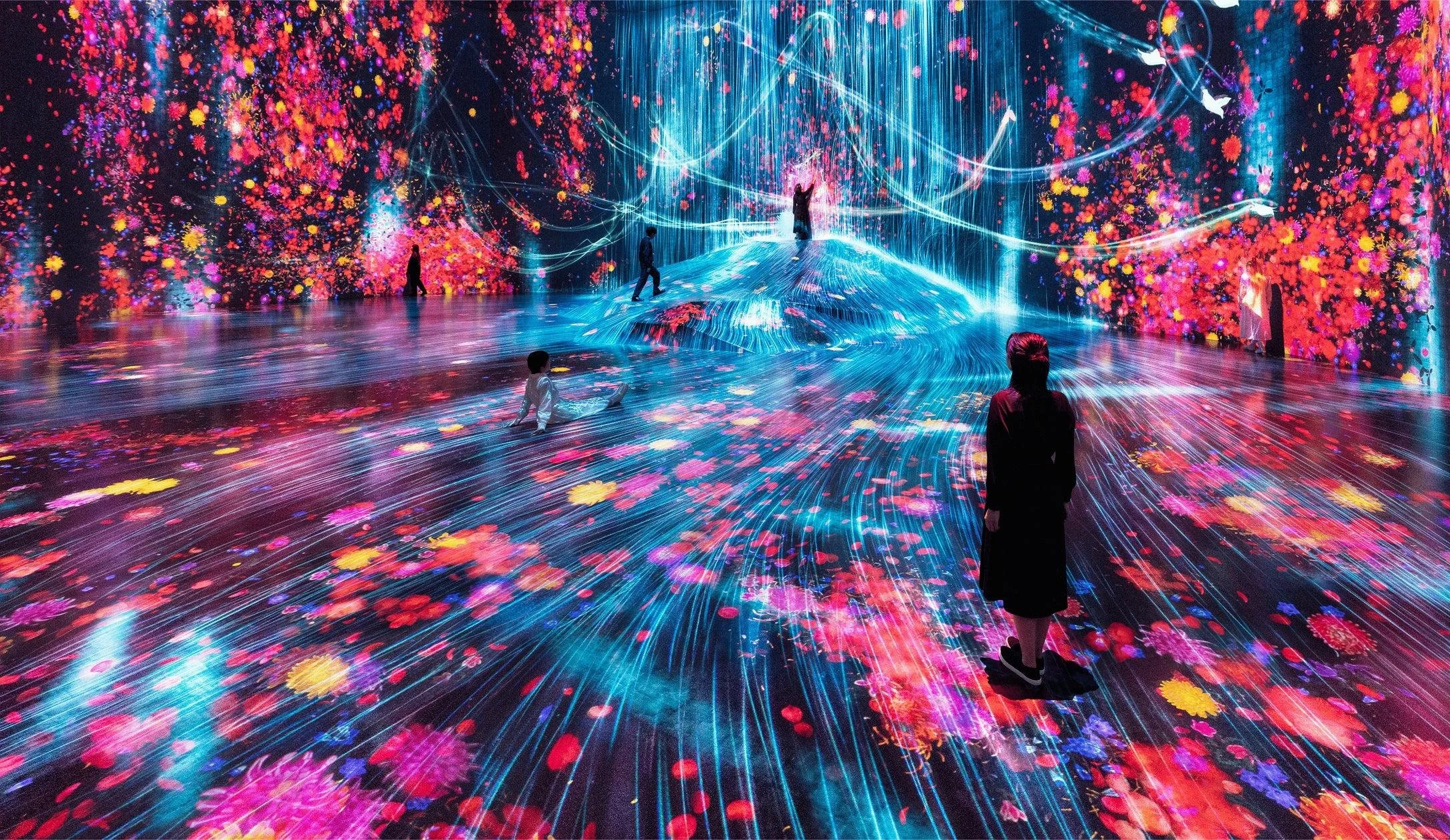
The Japanese art collective teamLab provides one of the clearest examples of how digital technology can transform exhibition space itself.
At teamLab Borderless in Tokyo's Azabudai Hills, which opened in February 2024, digital artworks extend across rooms and architectural boundaries, creating environments in which imagery continuously changes.
The collective's installations often respond to the movement and presence of visitors, dissolving the distinction between a fixed artwork and the space in which it is encountered.
In July 2026, teamLab introduced two further works at the venue, including A Hundred Chrysanthemums: Scattering, Returning to the Flow and Morning Glories on Vines of Light: Scattering, Returning to the Flow.
These additions demonstrate the capacity of digitally mediated exhibitions to evolve without necessarily requiring the architectural reconstruction associated with conventional installations.
Yet their significance extends beyond technical novelty.
The viewer becomes part of the work's changing conditions, challenging the assumption that artistic experience must be organised around passive observation.
There are, however, commercial and conservation implications.
Digital artworks depend on software, hardware, projection systems and maintenance procedures that may require continuous updating.
Their preservation differs fundamentally from that of traditional paintings or sculptures.
For collectors and institutions, questions of ownership, reproducibility and long-term technological support become central to evaluating such work.
The immersive museum consequently expands the possibilities of exhibition while introducing challenges that conventional gallery architecture was not designed to address.
The Return of the Private Residence
While immersive technology encourages increasingly spectacular environments, another significant development moves in the opposite direction.
Some galleries are returning art to intimate domestic settings.
Rather than displaying paintings against anonymous white walls, they present works within furnished apartments, historic residences or private interiors.
These environments allow collectors to consider how artworks interact with furniture, architecture, natural light and the scale of everyday living.
In Barcelona, El Principal de Còrsega operates from an apartment in the Eixample district.
The project, established by art historian Sònia Villegas, positions contemporary art within a domestic setting, encouraging personal encounters through exhibitions, conversations and visits by appointment.
Its approach draws on a history of apartment galleries, particularly those associated with Paris during the 1960s and 1970s.
In New York, Adam Zhu's Market Gallery developed an unconventional exhibition programme from a renovated storage shed connected to his Chinatown apartment.
The project subsequently expanded into a Soho pop-up exhibition in July 2025.
These initiatives demonstrate that the appeal of alternative exhibition spaces does not depend on scale or technological sophistication.
A domestic environment can create a different form of engagement by reducing the distance between audiences, artists and the circumstances in which artworks might eventually be owned.
However, private settings may also introduce limitations concerning accessibility, visitor capacity and professional infrastructure.
The apparent intimacy of an apartment gallery can be an advantage for relationship-building while remaining less suitable for large public audiences.
The Collector Experience as a Commercial Strategy
The growing interest in unconventional venues reflects changes in how galleries develop relationships with buyers.
The conventional exhibition opening remains important, but commercial engagement increasingly extends across private viewings, artist dinners, studio visits and invitation-only presentations.
These formats can provide opportunities for detailed conversations about artistic development, provenance and collecting strategy.
They also allow galleries to present artworks in contexts that resemble the environments in which collectors intend to display them.
For high-value transactions, the quality of personal engagement may be more consequential than the number of visitors attending an exhibition.
The Art Basel and UBS Survey of Global Collecting 2026 found that dealers remained the preferred purchasing channel among 29 per cent of high-net-worth respondents.
However, approximately two-thirds of those preferring dealers favoured transacting through websites, telephone, email or Instagram rather than physically purchasing within gallery premises.
The finding suggests that the gallery's commercial importance is becoming less dependent on a particular transaction location.
Collectors may still value exhibitions and personal relationships while completing purchases remotely.
This creates opportunities for galleries to treat physical spaces primarily as places of cultural engagement, with transactions conducted through multiple channels.
The exhibition and the sale are increasingly connected without necessarily taking place in the same environment.
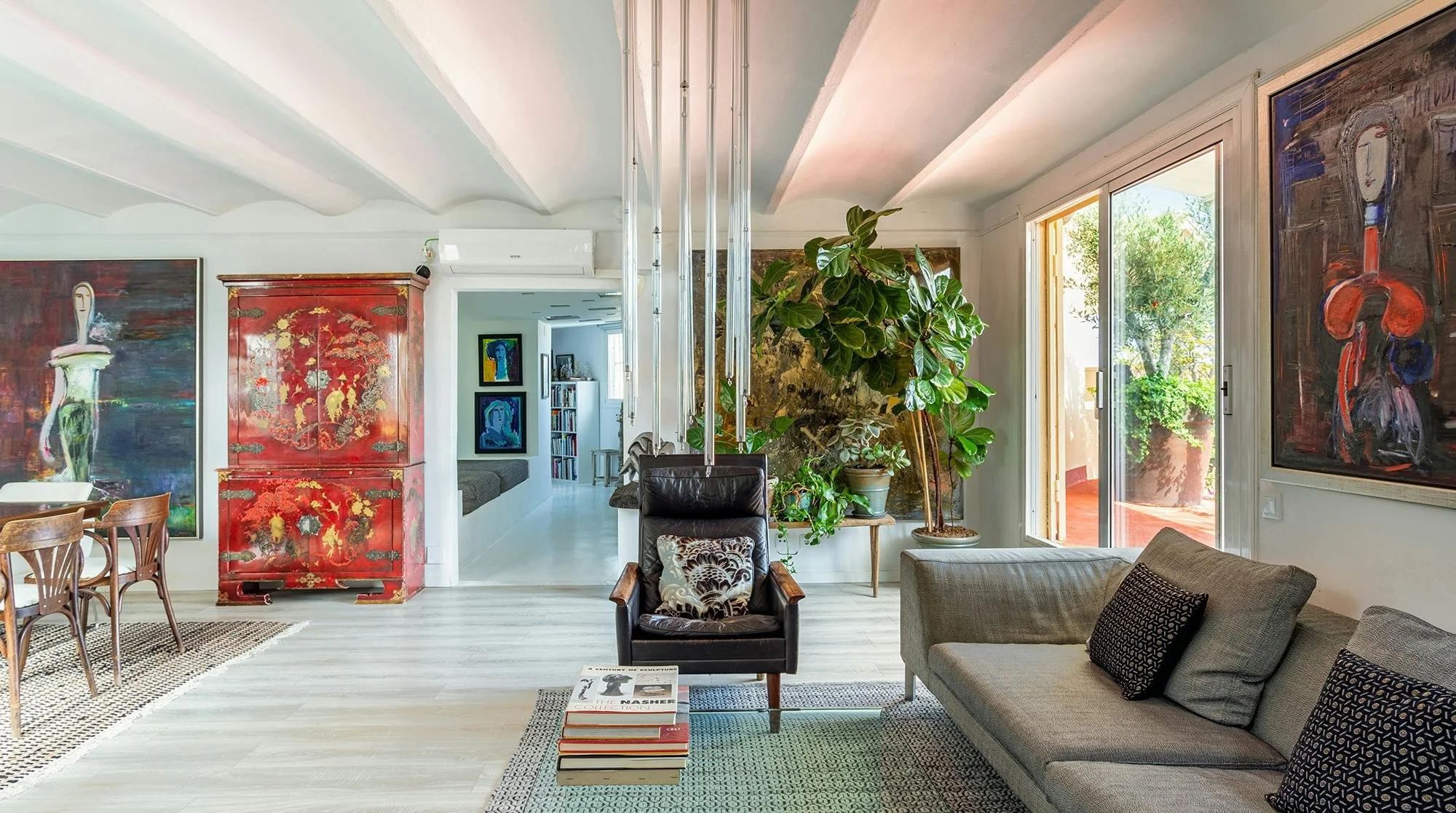
El Principal de Còrsega, Barcelona, an apartment gallery integrating contemporary art into a domestic environment and encouraging more personal encounters between artworks and collectors.
Digital Presentation Without Physical Ownership
The development of online viewing rooms, three-dimensional exhibition simulations and augmented-reality applications has expanded the ways artworks can be presented.
Collectors can assess available works through high-resolution images, examine documentation and communicate with galleries without travelling internationally.
Certain technologies also allow buyers to visualise artworks within domestic interiors.
These tools have practical value, particularly for international transactions where shipping works for preliminary inspection may be costly.
Nevertheless, digital presentation remains subject to limitations.
Screen colour, lighting conditions, surface texture and scale can significantly influence how artworks are perceived.
Even sophisticated visualisation cannot fully reproduce the material presence of certain paintings, sculptures or installations.
The latest market evidence also challenges assumptions about uninterrupted digital growth.
According to the Art Basel and UBS Art Market Report 2026, global online-only art sales declined to approximately $9.2 billion in 2025, their lowest level since 2019.
The online-only channel accounted for 15 per cent of total market sales, compared with a peak of 25 per cent in 2020.
For dealers, online sales represented 16 per cent of turnover in 2025, compared with 22 per cent in 2024.
These figures suggest that the future is unlikely to involve the straightforward replacement of physical galleries with digital platforms.
Instead, a hybrid structure is emerging in which online tools support discovery, research and transactions while physical exhibitions retain their importance for experience and relationship-building.
When Immersion Becomes a Marketing Device
The popularity of immersive environments creates a fundamental curatorial challenge.
An exhibition designed to engage audiences through spectacle may attract visitors without necessarily encouraging sustained attention to artistic ideas.
Large projections, interactive environments and visually dramatic installations are particularly well suited to photographic documentation and social media circulation.
This can generate considerable publicity, but attention is not equivalent to critical engagement.
The challenge is distinguishing between immersive work whose spatial or interactive qualities are integral to artistic meaning and exhibitions that use technical effects primarily to increase audience numbers.
Immersion is not, in itself, evidence of artistic innovation.
A technically elaborate installation may offer limited intellectual depth, while a modest exhibition in a conventional gallery may provide an exceptionally demanding aesthetic encounter.
For commercial operators, the temptation to prioritise visually recognisable experiences can be significant.
Ticket sales, sponsorship opportunities and social media visibility are measurable outcomes, whereas the cultural impact of an exhibition is more difficult to quantify.
The resulting tension is not unique to immersive venues. Museums and galleries have always balanced scholarly objectives with financial sustainability.
However, when the experience itself becomes the principal commercial product, these priorities may become more closely intertwined.
The Economic Risks of Experiential Art
Immersive venues can require substantial investment in architecture, equipment, fabrication, staffing and technical maintenance.
Projection systems, interactive sensors, lighting installations and customised software introduce recurring costs that differ from those associated with conventional exhibitions.
Commercial viability may depend on consistent visitor attendance, efficient capacity management and the ability to refresh programming.
When attendance weakens, the financial consequences can be significant.
Smaller independent galleries face a different set of constraints.
Temporary exhibitions may reduce long-term rental commitments, but they can increase spending on transport, installation and short-term production.
Private residential presentations may offer lower overheads while restricting visitor numbers and reducing opportunities for spontaneous discovery.
These models therefore involve trade-offs rather than universally lower costs.
The central economic question is whether the additional engagement generated by an alternative venue produces sufficient revenue, stronger collector relationships or broader institutional value to justify expenditure.
Without transparent financial information, it is difficult to establish whether experiential formats consistently outperform conventional galleries.
What can be observed is the increasing willingness of art businesses to experiment with how physical space contributes to their wider commercial strategies.
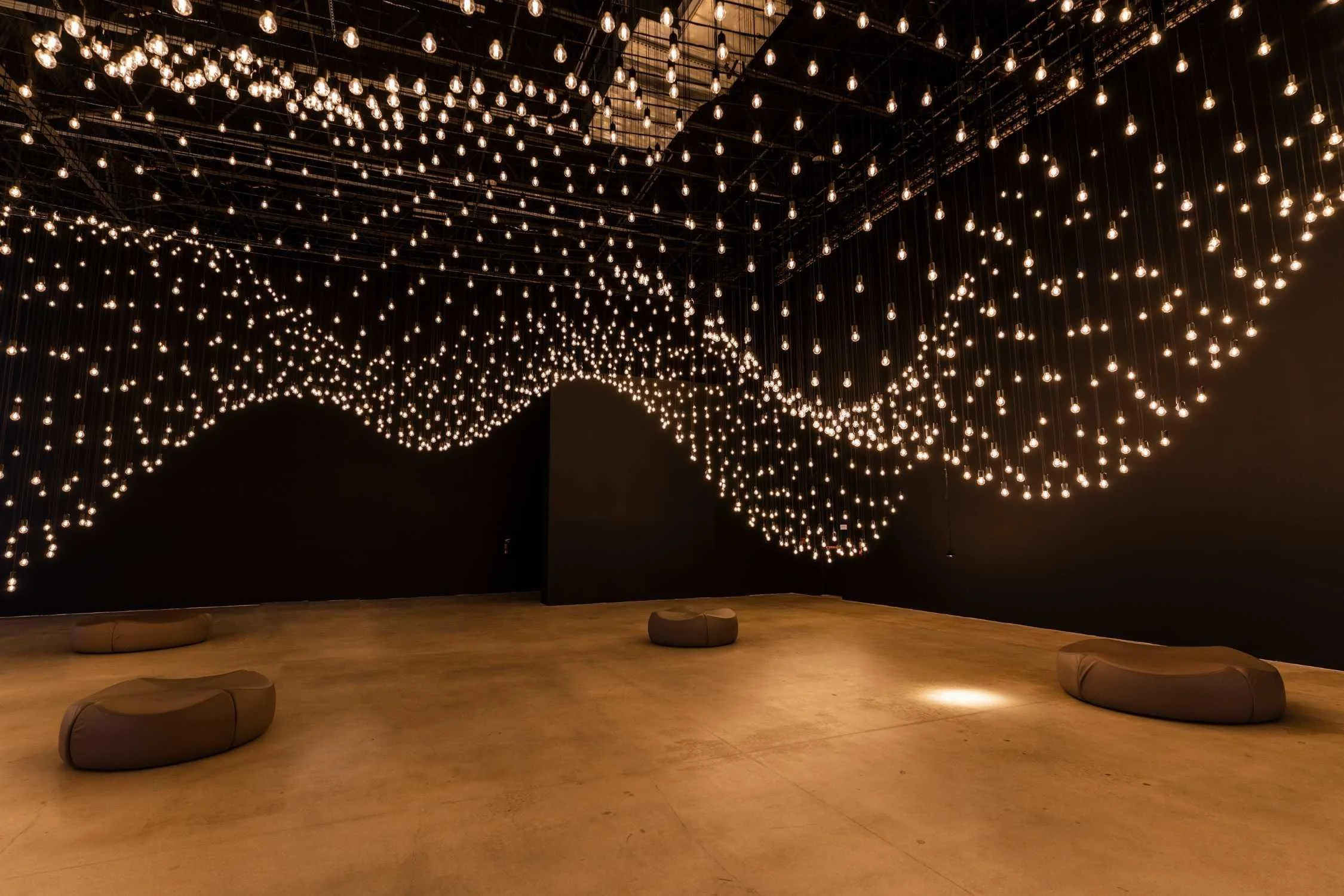
Rafael Lozano-Hemmer's Pulse Topology at Superblue Miami, 2022, where suspended lights create an immersive environment shaped by biometric interaction.
The Future of the Gallery: Destination, Platform or Private Network?
The next stage of gallery development is likely to involve greater differentiation rather than convergence around one model.
Major international galleries may continue investing in architectural destinations that support exhibitions, hospitality and public programming.
Smaller galleries may favour shared premises, temporary installations and appointment-based exhibitions.
Technology-focused organisations may develop new forms of presentation centred on interaction and digital environments.
Meanwhile, private residences and intimate exhibition settings may become increasingly relevant to collectors seeking more personal engagement.
The traditional white cube will remain valuable where its restrained architecture supports the direct examination of artworks.
Indeed, the continued importance of established galleries and art fairs suggests that physical presentation retains considerable economic and cultural significance.
The Art Basel and UBS Art Market Report 2026 found that art fair sales represented 35 per cent of dealer turnover in 2025, their highest share since 2022.
This resilience complicates narratives predicting the disappearance of conventional exhibition structures.
Collectors continue to value spaces in which artworks can be compared, examined and discussed within professional environments.
The more likely development is a pluralistic exhibition economy, with different architectural and technological models serving different artistic practices and commercial objectives.
Beyond the White Walls
The transformation of contemporary exhibition spaces should not be understood as a simple rejection of the gallery.
It reflects a reconsideration of the relationship between artistic meaning, physical environment and commercial exchange.
Immersive installations challenge the boundaries between viewer and artwork. Private residences introduce the intimacy of domestic experience. Architectural destinations expand the gallery into a broader cultural environment, while digital technologies allow exhibitions and transactions to operate across geographic boundaries.
Each model offers opportunities, but none provides a universal solution to the economic pressures facing the art market.
The most successful exhibition environments will be those in which spatial experimentation serves artistic purpose rather than substituting for it.
For galleries, the challenge is to develop experiences that deepen engagement while maintaining financial sustainability and critical credibility.
For artists, unconventional spaces can create opportunities to explore the relationship between artwork, audience and environment without accepting the limitations of established presentation formats.
For collectors, the proliferation of exhibition models offers greater choice, although the evaluation of artistic quality remains independent of how spectacularly a work is displayed.
The white cube is unlikely to disappear. Its architectural clarity and established cultural function will continue to serve important purposes.
What is changing is its position as the presumed ideal environment for contemporary art.
In an increasingly diverse cultural economy, the gallery is becoming less a fixed architectural category than a flexible system of relationships, experiences and forms of exchange.
The future of exhibiting art may therefore be defined not by the end of the white cube, but by the recognition that no single space can adequately accommodate the full range of contemporary artistic expression.