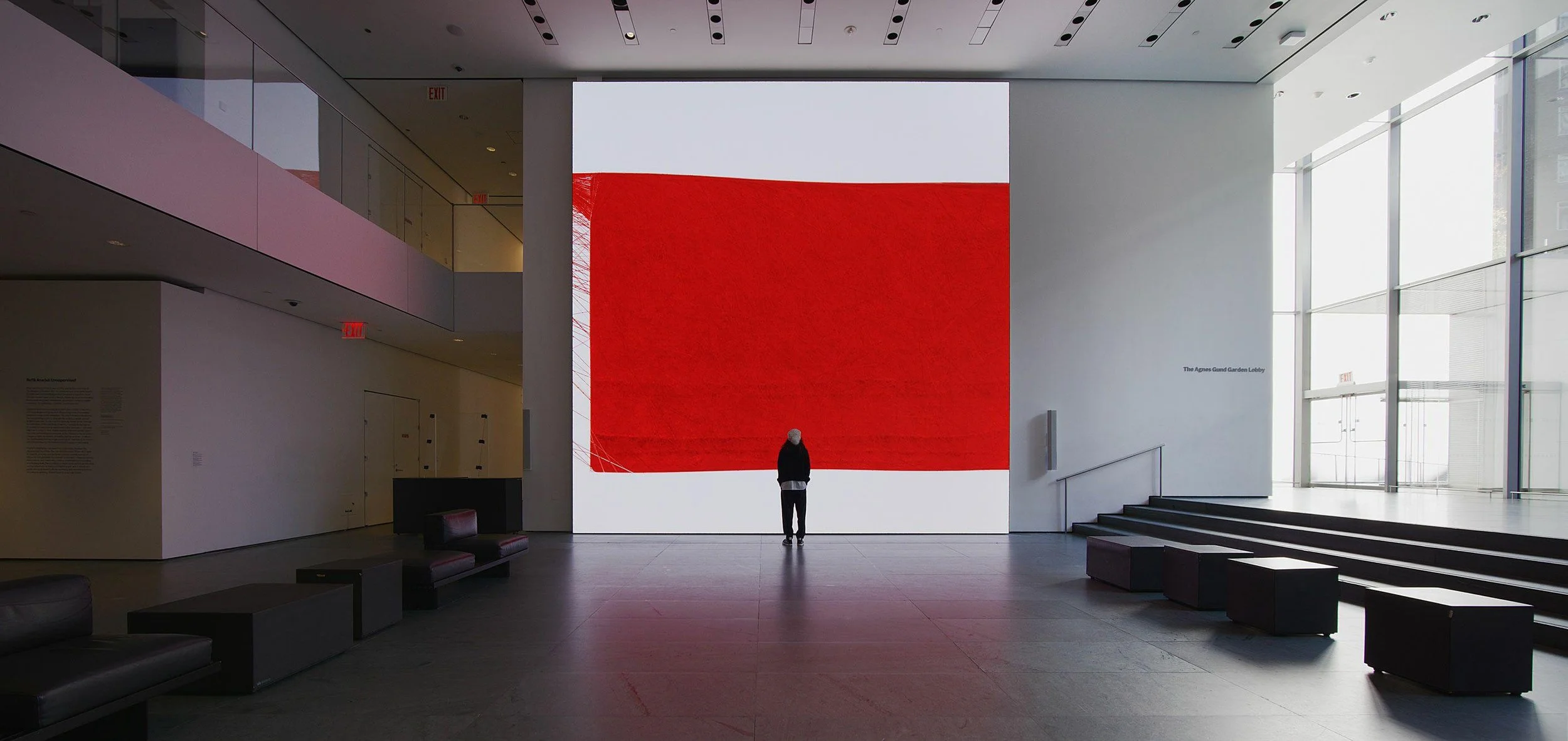
Artificial intelligence is moving beyond the production of digital images to influence how artworks are authenticated, researched, valued and acquired. As auction houses test demand for machine-assisted creativity and regulators reconsider the boundaries of authorship, the international art market faces a fundamental question: what constitutes artistic value when the capacity to generate images is becoming increasingly accessible?
The most consequential effect of artificial intelligence on the art market may have little to do with whether machines can produce convincing artworks. Its greater significance lies in the challenge it presents to the systems through which art acquires authority, ownership and financial value.
In March 2025, Christie's concluded Augmented Intelligence, its first auction devoted entirely to art created using artificial intelligence. The sale achieved $728,784, with Refik Anadol's Machine Hallucinations - ISS Dreams – A accounting for $277,200. Almost half of its bidders were millennials or members of Generation Z.
The figures were modest compared with major contemporary art auctions, yet their significance extended beyond revenue. They demonstrated that established commercial institutions were willing to present algorithmic art as a distinct collecting category.
By 2026, AI was also influencing the way collectors researched conventional artworks. The Art Basel and UBS Survey of Global Collecting found that 22% of surveyed high-net-worth collectors used applications or AI tools for advice, compared with 4% in 2024.
These developments expose a tension at the centre of the art economy. Technology can make images easier to produce and information easier to obtain, but the market continues to place exceptional value on scarcity, identifiable authorship and historical significance.
As 2027 approaches, the question is whether artificial intelligence will alter those foundations or reinforce their importance.
From Artistic Experiment to Commercial Recognition
Artificial intelligence did not arrive suddenly in contemporary art. Artists have used computational systems, algorithms and automated processes for decades.
Harold Cohen's pioneering AARON programme, developed from the 1970s onwards, established an important precedent for machine-assisted drawing. His work demonstrated that computer-generated imagery could form part of a sustained artistic investigation rather than merely reproduce an existing visual style.
More recent technologies have expanded the possibilities dramatically. Generative adversarial networks, machine-learning systems and diffusion models allow artists to develop images from datasets, textual instructions and iterative computational processes.
Yet the commercial history of AI art reveals how closely its success remains connected to established art-market institutions.
In October 2018, Christie's sold Portrait of Edmond Belamy, created by the French collective Obvious, for $432,500 against a high estimate of $10,000.
The result attracted international attention partly because the work's production challenged conventional assumptions about artistic authorship.
Seven years later, Christie's Augmented Intelligence auction presented a broader artistic field, including historic algorithmic practices, robotic painting, interactive work and contemporary generative art.
The $728,784 sale total should nevertheless be interpreted carefully. One successful specialist auction does not establish the size, liquidity or long-term resilience of an entire market category.
Indeed, the commercial distinction between computational art and inexpensive, mass-produced AI imagery is becoming increasingly important.
Collectors are not necessarily purchasing the technological capability to generate an image. They may be acquiring an identifiable work within a recognised artistic practice, supported by provenance, exhibition history, institutional attention and an established creator.
The financial value of such work depends on circumstances that cannot be reproduced simply by using the same software.
This suggests that AI may expand the range of artistic methods without automatically dismantling the traditional mechanisms through which cultural significance becomes commercial value.
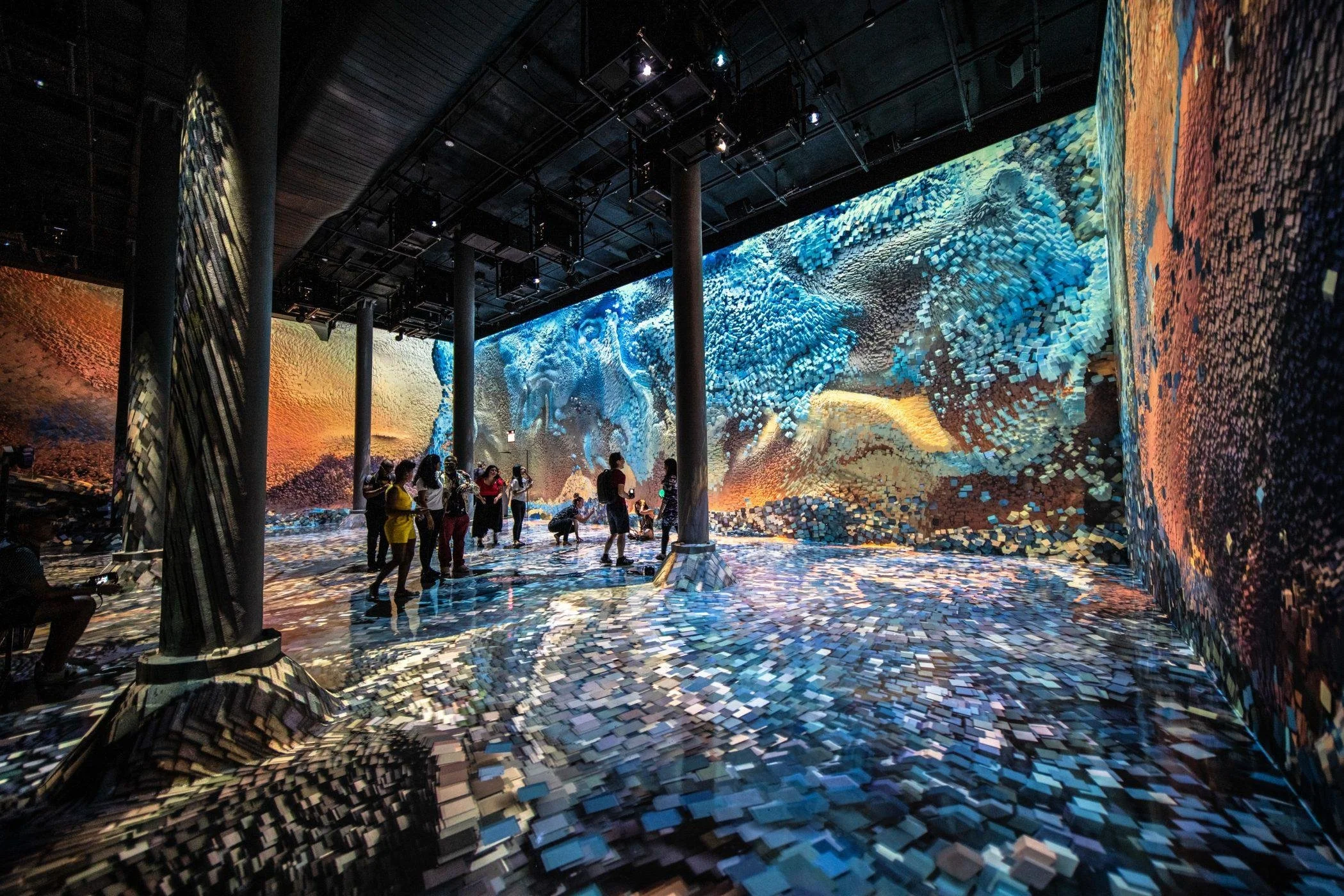
Refik Anadol, Machine Hallucinations, ARTECHOUSE, New York, 2019. Machine-learning technologies have become integral to artistic experimentation, creating new questions about authorship and creative ownership.
Who Owns an Artwork Created by Artificial Intelligence?
The most immediate legal challenge concerns authorship.
Copyright law generally developed around human creative activity. Generative systems complicate that framework because they can produce sophisticated images with varying degrees of human involvement.
The central issue is not whether software participates in production, but whether the resulting expression contains sufficient human authorship to qualify for protection under the applicable law.
In January 2025, the United States Copyright Office published its report on the copyrightability of AI-generated material. It concluded that protection may extend to works where a human determines sufficient expressive elements, including through creative arrangement or modification. Merely entering prompts, however, does not necessarily establish copyrightable authorship.
The distinction received further judicial support in March 2026 when the US Supreme Court declined to hear Stephen Thaler's challenge concerning an artwork said to have been generated autonomously by his AI system. The decision left intact lower-court rulings rejecting copyright protection for the machine-authored work.
These developments do not mean that every artwork incorporating artificial intelligence is excluded from copyright protection.
An artist might develop original source material, make substantial creative decisions, manipulate generated images and integrate the output into a larger composition. Depending on the circumstances, those human contributions may be protectable.
The problem becomes more complicated when the final work emerges largely from automated generation.
For collectors, uncertainty about copyright has commercial consequences.
Ownership of a physical print, digital file or other artistic object does not automatically confer exclusive copyright. A buyer may acquire the artwork without acquiring the legal right to prevent others from producing or distributing similar images.
The distinction matters especially for digital works that can be reproduced at negligible marginal cost.
By 2027, contractual documentation could become an increasingly important component of AI-art transactions. Collectors may demand clearer information about human authorship, permitted reproductions, edition restrictions, licensing arrangements and the rights retained by artists or technology providers.
In this environment, legal certainty may become a meaningful element of market value.
Training Data and the Economics of Creative Ownership
The controversy surrounding AI art extends beyond the status of generated works to the materials used to train the systems that produce them.
Generative models can be trained on extensive collections of images, including artworks and photographs protected by copyright.
Artists, photographers and rights holders have questioned whether their work can legitimately be used for commercial model development without permission or compensation.
Technology companies, meanwhile, have advanced legal arguments concerning the transformative nature of machine learning and the extent to which existing copyright exceptions may apply.
These questions remain subject to differing national laws and continuing litigation.
In November 2025, the High Court in London delivered judgment in the dispute between Getty Images and Stability AI.
The litigation concerned allegations involving copyright, database rights and trade marks. By the time of judgment, Getty had abandoned significant elements of its original copyright case. The court rejected the remaining secondary copyright infringement claim but found limited historical trade mark infringement.
Crucially, the judgment did not establish a universal principle that training AI systems on copyrighted artworks is lawful.
The United States Copyright Office's May 2025 report on generative AI training similarly examined the competing rights and interests involved, demonstrating the complexity of applying copyright principles to systems developed from large collections of existing material.
For the art market, the economic implications extend beyond legal liability.
If generative AI companies can develop commercially valuable technologies using creative material without a corresponding licensing market, artists may struggle to participate in the revenue generated from their work.
Conversely, excessively restrictive licensing arrangements could favour large companies and institutions capable of negotiating access to extensive datasets, while limiting opportunities for independent artistic experimentation.
One possible development is a more formal market for licensed artistic training material.
Artists, estates, image libraries and cultural institutions could negotiate permissions, establish compensation systems or impose restrictions on specific uses.
Such models might create new revenue opportunities while improving the traceability of creative inputs.
However, no comprehensive international framework for compensating artists whose works appear in AI training datasets has been established. Any prediction of widespread licensing by 2027 remains conditional on legal, commercial and technological developments.
Authentication and Provenance: Can Algorithms Establish the Truth?
Artificial intelligence may have an even more significant influence on artworks that were created without it.
Authentication is among the most consequential and financially sensitive activities in the art market. A change in attribution can alter an artwork's value dramatically, while doubts about authenticity can make an otherwise important object commercially difficult to sell.
Machine-learning systems offer new approaches to examining visual characteristics, including brushwork, compositional structures and patterns that may be difficult to identify through conventional observation.
Yet technological sophistication should not be confused with definitive evidence.
An authentication model is only as reliable as its training material, analytical methods and relevance to the particular artwork under examination.
Historic paintings present especially difficult problems because an artist's technique may vary across decades, while restoration, deterioration, workshop participation and changing materials can complicate comparisons.
A statistical resemblance to authenticated paintings cannot independently prove authorship.
Nor can an algorithm necessarily distinguish between a work produced by an artist, one created by a talented contemporary imitator and an authentic workshop painting incorporating several hands.
AI analysis is therefore most valuable when combined with provenance research, technical examination, documentary evidence and independent scholarly judgement.
Digital provenance technologies present a related opportunity.
Research published in IEEE Computer Graphics and Applications in 2024 examined how metadata, fingerprinting and watermarking can provide complementary evidence concerning the origin and development of digital images.
Such approaches may help establish when a digital work was created, whether it has been altered and which technical processes contributed to its production.
They cannot, however, guarantee the accuracy of information supplied at the outset. A securely recorded provenance claim is not necessarily a truthful one.
For collectors, the distinction is essential. AI may improve the efficiency of due diligence, but it should strengthen rather than replace the human and institutional responsibilities underlying authentication.
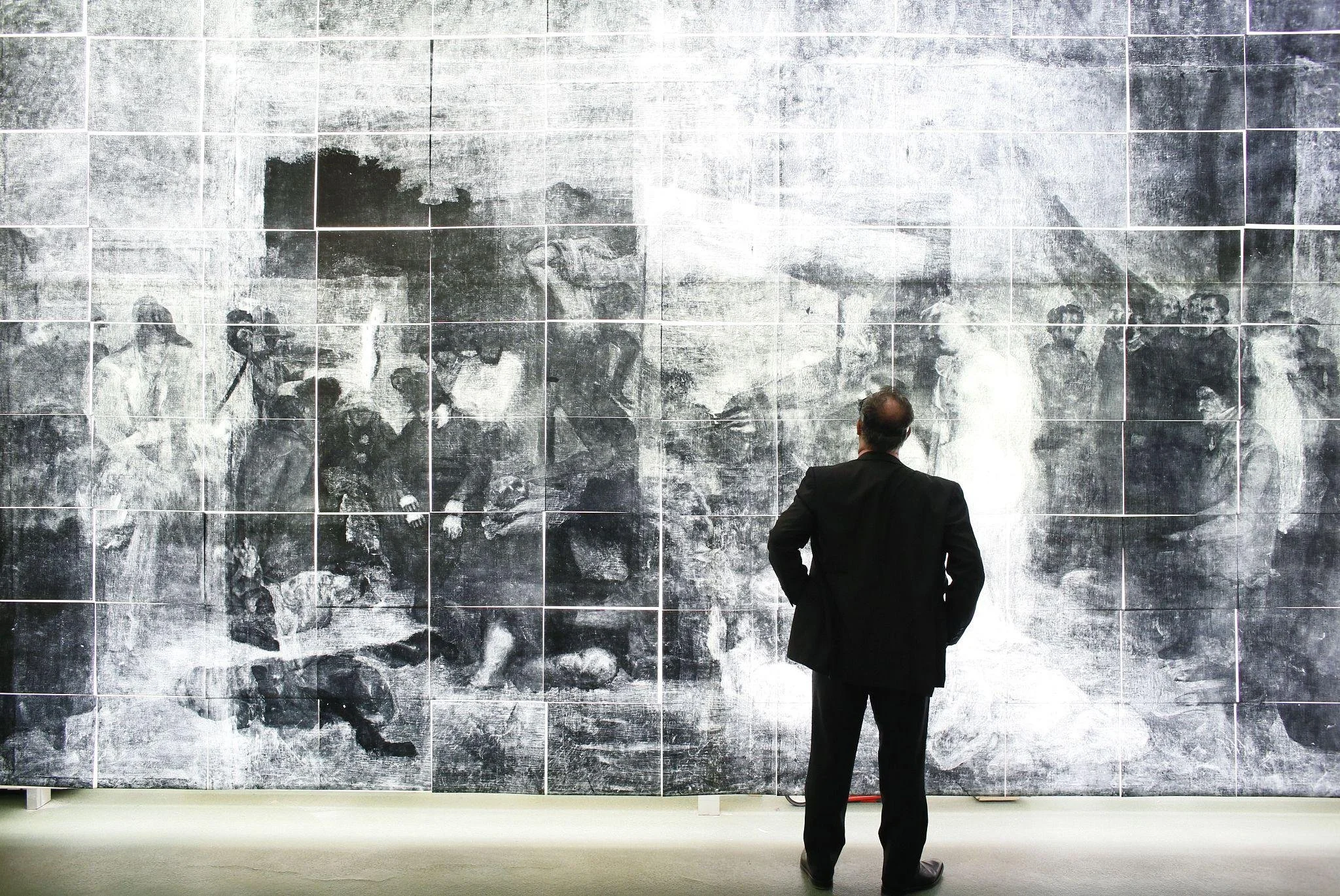
Technical examination of an artwork's radiographic documentation. Scientific analysis, provenance research and specialist judgement remain essential to the authentication of valuable artworks, even as artificial intelligence introduces new analytical tools.
Art Valuation in an Age of Predictive Technology
Artificial intelligence is also entering a market where valuations have traditionally depended on specialist expertise and incomplete information.
Machine-learning models can analyse auction results, historical price movements, exhibition records and other indicators to identify patterns across large datasets.
This capability could improve research efficiency, particularly for artworks with substantial transaction histories.
According to the Art Basel and UBS Survey of Global Collecting 2026, 64% of surveyed high-net-worth collectors viewed AI's potential influence on pricing and valuation analysis positively. Some 65% expressed positive views about its role in provenance and authenticity verification.
These responses reveal considerable confidence in technology's potential, although expectations are not evidence of established accuracy.
Art valuation presents difficulties that distinguish it from conventional statistical forecasting.
Many artworks are unique, transactions occur infrequently and a substantial proportion of market activity takes place privately.
The quality of an individual work can matter more than the average performance of its creator.
An exceptional painting with significant provenance may achieve a multiple of the price obtained by another work from the same period.
Algorithms trained primarily on public auction results may also overlook important private transactions, unsuccessful sales and changes in institutional reputation.
There is a further danger that predictive systems could reinforce established commercial hierarchies.
If historical auction performance becomes a central indicator of future value, artists with limited sales records or institutional visibility may receive systematically weaker assessments.
That would be a limitation of the available evidence rather than a reliable measure of artistic significance.
By 2027, AI-assisted valuation may become more common in preliminary research, portfolio monitoring and risk assessment. Nevertheless, treating automatically generated estimates as authoritative prices would overlook the fundamentally heterogeneous character of artworks.
The most credible application is likely to combine computational analysis with expert interpretation and explicit acknowledgement of uncertainty.
The Collector's Dilemma: Scarcity, Authenticity and Cultural Significance
The commercial future of AI-generated art ultimately depends on what collectors believe they are acquiring.
When images can be generated rapidly, visual novelty alone may become an insufficient foundation for lasting value.
Scarcity must be established through other mechanisms, including limited editions, controlled distribution, unique physical manifestations or the significance of the artist's creative process.
Yet scarcity created through contractual restrictions is not equivalent to the historical uniqueness of an individual painting.
Digital editions can restrict authorised distribution, but technological controls do not necessarily prevent copying or guarantee continuing commercial demand.
The more meaningful distinction may lie in the relationship between an artwork and its creator.
An artist who develops a sustained investigation into machine learning, human perception or the politics of data occupies a different cultural position from a producer generating interchangeable images through commercially available software.
The market is beginning to recognise this difference.
Refik Anadol's commercial and institutional presence reflects an identifiable artistic practice involving datasets, computational systems and immersive environments, rather than merely the use of an image-generation tool.
The broader history of technological art also suggests that a medium's initial novelty is rarely sufficient to sustain long-term significance.
Photography, video and digital art all required systems of critical interpretation, institutional recognition and collecting practice before achieving their present positions within contemporary art.
AI-generated art may follow a similarly uneven trajectory, with a small number of historically significant practices attracting sustained attention while much of the wider output remains commercially interchangeable.
The market's central task will be to distinguish artistic contribution from technological spectacle.
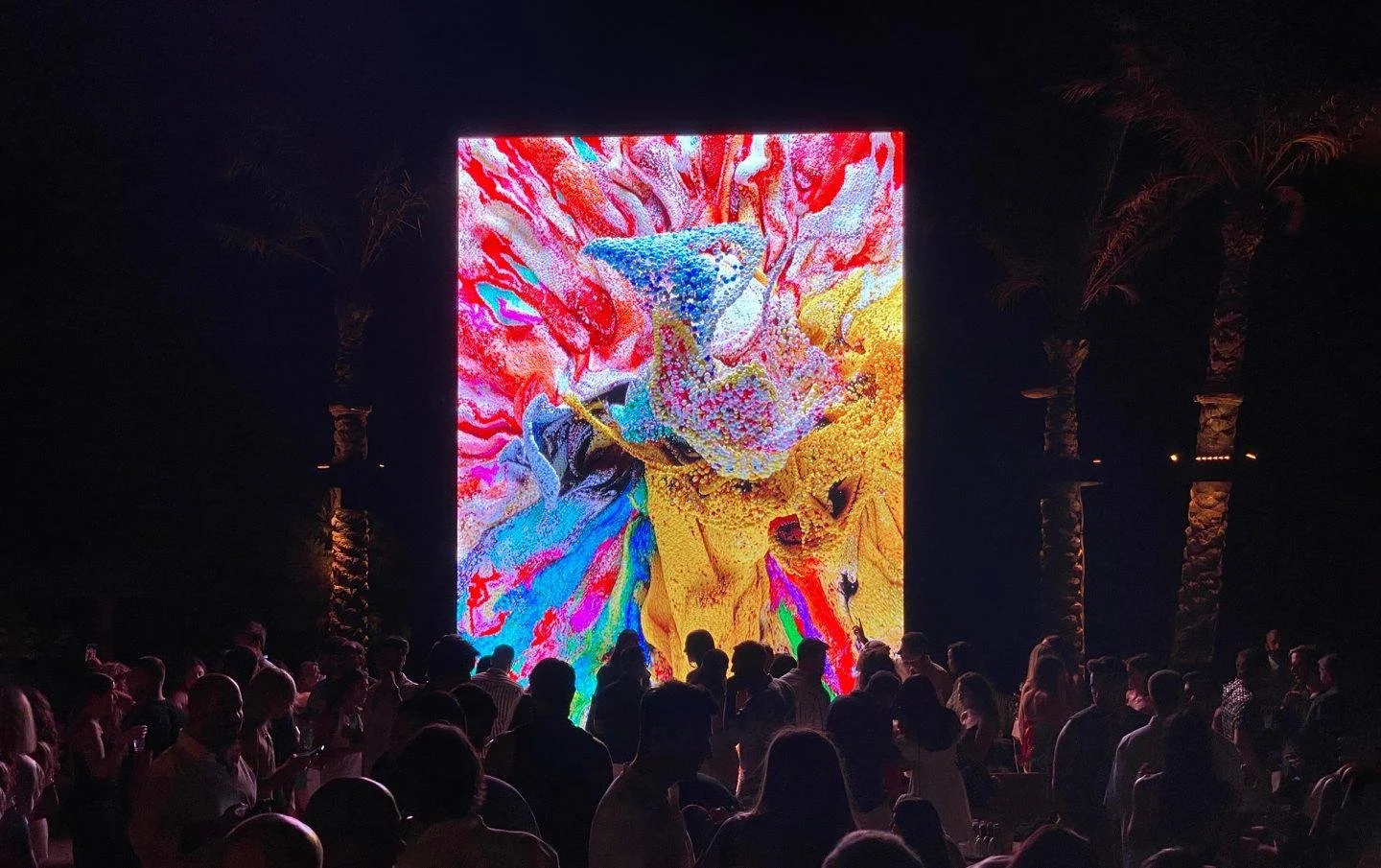
Refik Anadol, Winds of Yawanawa, 2024. Generative art raises increasingly important questions about artistic intention, digital scarcity and the long-term value of machine-assisted creativity.
Regulation and the Outlook for 2027
Regulatory developments are already beginning to shape the commercial environment.
Under the European Union's AI Act, obligations concerning general-purpose AI models began applying in August 2025, including requirements relating to copyright compliance policies and public summaries of training content.
Further transparency requirements under Article 50 became applicable in August 2026, including machine-readable marking of certain AI-generated material and disclosure obligations for specified categories of synthetic content. The legislation also contains particular provisions for artistic and creative works.
These measures do not establish a universal requirement that every AI-assisted artwork carry a public label identifying its method of production.
They do, however, demonstrate an important regulatory direction: synthetic media increasingly requires systems capable of communicating its origins and distinguishing it from other content.
For galleries and auction houses, this may encourage more detailed descriptions of artistic processes, software dependencies and the degree of human intervention.
For collectors, such disclosures could become part of the information used to assess authenticity, legal rights and long-term conservation.
Digital preservation introduces an additional challenge. An artwork dependent on proprietary software, external datasets or particular computing infrastructure may require continuing technical support.
If the underlying systems become unavailable or commercially obsolete, preserving the work may be more complex than maintaining a conventional physical object.
Contracts governing access, migration, exhibition and restoration could therefore become increasingly important.
These developments are plausible directions for 2027, not evidence that the market has already adopted consistent standards.
The decisive question is whether technological innovation will be accompanied by legal clarity and institutional responsibility.
Conclusion: The Value of Human Intention
Artificial intelligence presents the international art market with two developments that should not be confused.
The first is the emergence of new forms of artistic production, in which computational systems become materials, collaborators or conceptual subjects. The second is the expanding use of AI as commercial infrastructure, influencing how artworks are researched, authenticated, valued and exchanged.
Both developments may become more significant in 2027, but neither guarantees a fundamental redistribution of artistic or financial value.
Legal uncertainty continues to surround authorship and training data. Authentication technologies require careful validation, while automated valuations remain constrained by fragmented transaction records. Meanwhile, the commercial appeal of AI-generated imagery must be distinguished from the lasting significance of a particular artistic practice.
For collectors and institutions, the most important question is not whether artificial intelligence can produce an image that resembles art. It is whether a work possesses the authorship, conceptual purpose, provenance and cultural relevance necessary to justify sustained attention.
Technology may change the means of production and the efficiency of market analysis. It does not eliminate the need for critical judgement.
As the art market moves towards 2027, the enduring value of creativity may depend less on the distinction between human and machine-made images than on the ability to identify meaningful artistic intention within an increasingly automated visual culture.