

As collectors increasingly seek discretion, personalised advice and greater control over transactions, private sales have become an essential component of the international art market. Their influence extends beyond commercial negotiations, raising fundamental questions about pricing transparency, market access and the institutions that determine the value of art.
The most consequential transactions in the international art market do not always take place beneath the lights of an auction room. Some are negotiated over months, conducted through trusted intermediaries and concluded without a public announcement. The price may remain confidential, the buyer unidentified and the artwork absent from any published sales record.
This largely invisible market has become an important arena for collectors, galleries, auction houses and advisers competing to secure exceptional works.
Its significance, however, is more complex than a straightforward shift away from public auctions. According to the Art Basel and UBS Global Art Market Report 2026, private sales conducted by auction houses declined by approximately 5% in 2025 to just under $4.2 billion, while public auction sales increased by 9% to $20.7 billion. The previous year had shown the opposite pattern, with private auction-house sales growing as public auctions contracted.
These fluctuations reveal a market in which private transactions serve different purposes under different economic conditions. When confidence weakens, discretion and price control become especially valuable. When competitive bidding strengthens, the prospect of exceeding expectations can draw sellers back to public auctions.
Understanding the growing strategic importance of private sales therefore requires looking beyond transaction volumes to the relationships, financial incentives and information advantages that increasingly shape how art changes hands.
The Economics of Selling Art Without an Audience
Private transactions have always formed part of the art market. Galleries traditionally conduct sales through direct relationships with collectors, while dealers and intermediaries facilitate the transfer of artworks between private owners.
What has changed is the sophistication with which major auction houses now compete for this business.
Public auctions operate through a relatively transparent mechanism. Works are presented with estimates, potential buyers submit competing bids and the final hammer price becomes part of the public record.
Private sales follow a different economic logic.
A seller may establish an asking price with an intermediary, who then identifies potential purchasers through existing relationships. Negotiations can take place individually, with considerable flexibility over timing, payment arrangements and conditions of sale.
The transaction does not depend on the intensity of demand within a particular auction session.
This flexibility matters because art is an illiquid asset. An owner wishing to sell a substantial painting may face uncertainty about whether enough qualified buyers will participate in a scheduled auction. Even a highly desirable work can fail to sell if its reserve price exceeds the bids available on the day.
A private transaction allows the seller to approach the market more selectively.
The advantages are not entirely financial. A collector considering the disposal of an important work may wish to avoid public speculation about personal circumstances, a changing investment strategy or the performance of a particular artist.
Private sales can accommodate these considerations while allowing both parties to negotiate terms that may be difficult to reproduce at auction.
Yet confidentiality comes at a cost. Without open competition, the seller may never discover whether another collector would have paid substantially more.
Private transactions exchange the potential advantages of competitive price discovery for greater control over the selling process.
Why Auction Houses Are Investing in Private Relationships
The major international auction houses have increasingly positioned themselves as year-round advisers and transaction specialists rather than businesses dependent solely on scheduled sales.
Christie's provides a revealing example.
In its December 2025 financial announcement, the company reported projected global sales of $6.2 billion, including approximately $1.5 billion in private transactions. This represented 24% of its total business.
Seventeen works sold privately for more than $15 million each, compared with thirteen in 2024. Half of the buyers participating in the private-sales channel were new to that channel, while the three highest-value works sold by Christie's during the year were all transacted privately.
These figures demonstrate that private negotiations are no longer a peripheral service reserved for occasional exceptional consignments.
They have become a significant commercial operation.
Nevertheless, the distinction between company performance and wider market conditions is important. Christie's stable private-sales total in 2025 contrasted with the decline recorded across the auction-house private-sales sector. Individual businesses may gain market share even when aggregate activity weakens.
Private sales also offer auction houses an important form of revenue diversification.
Public auctions require substantial expenditure on marketing, cataloguing, exhibitions, specialist staff and logistical arrangements. Private transactions have their own costs, but they can generate revenue through more flexible commercial processes without requiring an entire auction event.
They also deepen relationships with collectors.
An auction house that advises a client on a private purchase may subsequently become involved in collection management, valuation, financing, estate planning and eventual resale.
The commercial value of these relationships can extend far beyond an individual transaction.
For the largest auction houses, the competition is therefore not simply to sell more artworks. It is to become an indispensable intermediary throughout the collector's ownership cycle.

Interior of Sotheby's S|2 Gallery in London, reflecting the role of dedicated exhibition spaces in presenting artworks to collectors beyond the public auction room.
The Growing Importance of Art Advisers and Specialist Networks
The development of private sales has strengthened the position of independent art advisers, who operate between collectors, galleries, auction houses and other owners.
Their influence derives principally from access to information.
An experienced adviser may know that an important artwork is potentially available even though it has never been publicly offered. Equally, the adviser may understand which collectors are actively seeking works from a particular period or artist.
Such knowledge can allow a transaction to develop without the artwork entering an open marketplace.
In the 2026 Art Basel and UBS Survey of Global Collecting, 30% of surveyed high-net-worth collectors identified art advisers as a source of external advice, compared with 31% who consulted auction-house experts and 27% who used dealers. The survey covered 3,100 collectors across ten major markets.
The figures demonstrate the continuing relevance of specialist intermediaries, even as collectors gain access to digital research tools.
The adviser's role, however, requires careful scrutiny.
Unlike financial advisers operating within highly standardised investment frameworks, art advisers work within a market where professional qualifications, fee structures and commercial arrangements can vary significantly.
Some operate primarily on retainers or clearly disclosed fees. Others may receive commissions associated with completed purchases or sales.
Where an intermediary receives compensation from more than one party, conflicts of interest can arise if these arrangements are not fully disclosed.
The same issue applies when advisers have financial interests in artworks they recommend.
For collectors, the central question is whether the intermediary's incentives align with their own.
Trusted relationships may reduce information costs and facilitate access, but trust should not replace independent verification of provenance, ownership, condition and pricing.
Private Sales and the Problem of Price Transparency
One of the most consequential effects of private transactions concerns the information available to the wider market.
Public auction results create reference points that collectors, insurers, advisers and financial institutions can use when assessing valuations.
These figures are imperfect. Auction prices reflect the particular characteristics of works offered, the conditions of individual sales and sometimes the influence of financial guarantees.
Nevertheless, they provide observable evidence.
Private sales produce far less information.
A painting may change hands for a substantial amount without any public record of the agreed price. Even when a transaction becomes known, details concerning commissions, financing, guarantees or other contractual terms may remain undisclosed.
This reduces the availability of comparable transactions.
The consequences extend beyond collectors directly involved in a sale. Galleries establishing prices, estate administrators assessing collections and lenders evaluating collateral may all encounter greater uncertainty when important artworks are traded privately.
Consider two paintings by the same artist.
One achieves $5 million at public auction, establishing a widely reported benchmark. The other sells privately for an undisclosed amount. Although the second work may be more significant artistically, its transaction contributes little to publicly observable price discovery.
Over time, a growing volume of confidential transactions can make published auction results less representative of the total market.
This is especially relevant at the highest price levels, where relatively few works of comparable importance become available.
A further complication is the distinction between an asking price and an agreed price. Private-market quotations can circulate among intermediaries without establishing whether buyers are willing to transact at those levels.
Consequently, greater private-sales activity does not necessarily improve pricing efficiency.
It may improve the ability of individual buyers and sellers to negotiate suitable agreements while simultaneously reducing transparency for everyone outside those negotiations.
Why Collectors Value Discretion
The appeal of confidential transactions cannot be explained exclusively through financial strategy.
For many collectors, privacy is an important part of ownership.
The 2026 Art Basel and UBS collecting survey found that 64% of respondents preferred to keep their collections private within their household or a restricted circle, while only 10% sought broad public recognition as collectors.
These preferences challenge the conventional assumption that art collecting is primarily an exercise in conspicuous consumption.
An important collector may want access to exceptional works without public attention. Privacy can protect personal security, preserve family confidentiality and limit unwanted scrutiny of financial arrangements.
For sellers, discretion may also help protect an artist's market.
A public auction failure becomes visible to collectors and advisers internationally. An unsuccessful private negotiation usually leaves no comparable record.
This distinction can influence decisions about when and how to offer artworks.
However, confidentiality should not be confused with secrecy from relevant authorities or counterparties.
Legitimate privacy concerns can coexist with obligations to establish ownership, verify the source of funds and comply with applicable legal requirements.
The challenge is preserving appropriate commercial discretion without allowing private transactions to weaken accountability.

Art collector Ambrose Lee and Christie's senior client adviser Henry Cheng examine contemporary artworks, illustrating the importance of personal relationships and specialist advice in the international private art market.
The Regulatory Consequences of a Confidential Market
The art market's reliance on intermediaries has attracted greater attention from financial regulators because high-value objects can be transferred through complex ownership structures.
In the United Kingdom, anti-money-laundering obligations apply to qualifying art market participants conducting transactions of €10,000 or more, including linked transactions that collectively meet the threshold.
HM Revenue & Customs guidance updated in 2026 identifies anonymity, intermediaries, unusual transaction structures and inadequate information about beneficial ownership as potential risk factors.
The government's 2025 National Risk Assessment classified art market participants as presenting a medium risk of money laundering, a reduction from the previous high-risk assessment, while emphasising that vulnerabilities remain.
The regulatory issue is not that private sales are inherently suspicious.
Most private art transactions serve legitimate commercial and personal purposes.
The concern is that arrangements designed to preserve confidentiality can also make it difficult to establish the identities of those ultimately controlling a transaction.
For international dealers and auction houses, compliance increasingly requires the integration of financial due diligence into longstanding relationship-based business models.
This can introduce additional costs and administrative complexity.
At the same time, stronger documentation may improve market confidence by reducing uncertainty about provenance, ownership and financial legitimacy.
The long-term credibility of private sales will depend partly on the industry's ability to distinguish commercial confidentiality from inadequate transparency.
Private Transactions and Institutional Collecting
Private sales also play an important role in the acquisition strategies of public museums.
Institutions may seek works that are rarely available at auction or whose owners prefer discreet negotiations.
In its 2025 results, Christie's highlighted several museum acquisitions facilitated by its private-sales division, including Edgar Degas's Ballet Dancers, acquired by the National Gallery in London, and an important portrait of King David by Guercino.
The company also reported facilitating acquisitions of a marble relief by John Deare for the Victoria and Albert Museum and medieval manuscripts for the British Library.
These examples demonstrate that private transactions can contribute directly to public cultural access.
By connecting institutional buyers with private owners, intermediaries may help transfer significant works into collections where they can be preserved, researched and exhibited.
Nevertheless, institutional acquisitions also raise questions about valuation.
Museums operate under financial constraints and public responsibilities that differ from those governing private collectors.
Where prices remain confidential, external observers may have limited information with which to assess the financial terms of an acquisition.
Institutions must therefore balance the discretion required to secure important works with their responsibilities to trustees, donors and the public.
Private transactions can support cultural stewardship, but their contribution is strongest when accompanied by appropriate internal governance and independent valuation.
A Market Defined by Relationships Rather Than Visibility
The growing strategic importance of private sales does not mean that public auctions are becoming obsolete.
The 2025 figures demonstrate that auctions remain powerful mechanisms for price discovery and competition.
Nor should the size of the dealer sector be treated as evidence that all its transactions are confidential secondary-market sales. The $34.8 billion dealer total reported by Art Basel and UBS includes primary-market sales, secondary-market transactions and activity conducted through galleries and art fairs.
What the figures establish is the continuing importance of negotiated, relationship-based transactions across the art economy.
The 2026 collecting survey found that 87% of respondents had purchased through dealers during the preceding year, with 75% buying directly and 62% purchasing at art fairs. Dealers accounted for 42% of surveyed collecting expenditure when direct purchases and art fairs were combined.
These results suggest that personal relationships remain central even among collectors who increasingly research artworks independently.
Digital platforms can improve discovery, but access to exceptional works frequently depends on established networks.
The economic advantage consequently belongs not only to those possessing financial resources, but also to intermediaries capable of identifying suitable buyers and sellers.
This creates a market in which information itself becomes a valuable commercial asset.
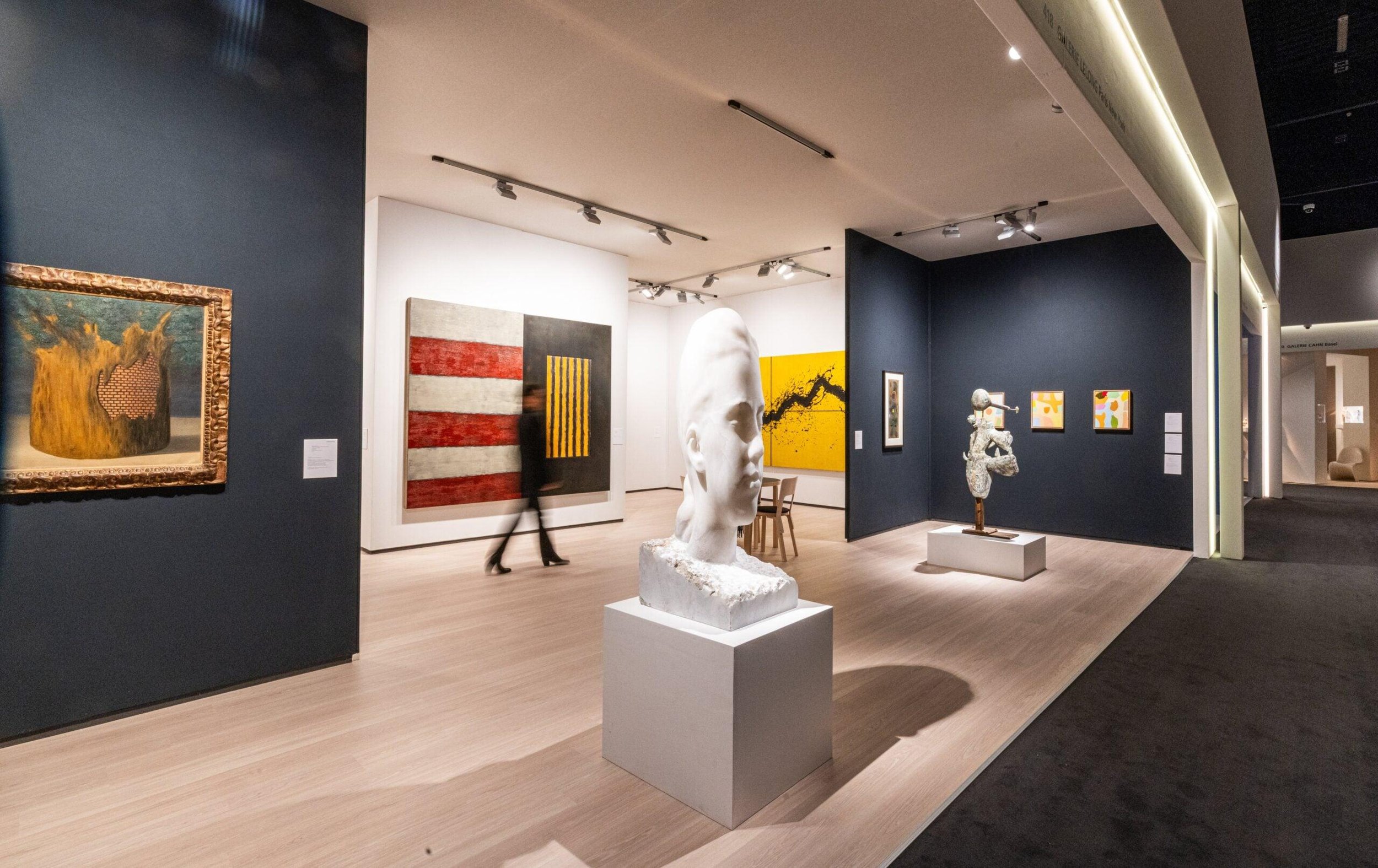
Exhibition view at TEFAF Maastricht 2025, where international galleries and specialist dealers connect important artworks with private collectors. Photograph: Loraine Bodewes, courtesy TEFAF.
Conclusion: The Future of Art Trading Beyond Public Auctions
Private sales are reshaping the art market not by replacing auctions, but by expanding the range of mechanisms through which important works can change ownership.
Their appeal rests on flexibility, discretion and the ability to negotiate outside the pressures of a scheduled public sale. For collectors and institutions, these characteristics can provide meaningful advantages, particularly when transactions involve exceptional artworks or complex circumstances.
Yet the expansion of confidential trading also exposes structural weaknesses in price transparency, intermediary accountability and access to reliable market information.
As the industry moves towards 2027, its challenge will be to preserve the advantages of private negotiation without allowing the market to become increasingly opaque.
Public auctions will continue to provide visible benchmarks and opportunities for competitive bidding. Private sales will offer alternative routes where relationships, timing and confidentiality carry greater importance.
The most consequential development is therefore not a simple movement from public to private transactions. It is the increasing sophistication with which the art market matches individual artworks to individual buyers.
In a market built around objects that are unique, culturally significant and frequently illiquid, commercial success depends on more than achieving a headline price.
It depends on identifying the right buyer, establishing confidence in the transaction and determining whether discretion or competition offers the stronger outcome.
The future of art trading may be shaped as much by negotiations the public never sees as by the records celebrated beneath the auction hammer.