
From major retrospectives to permanent collection acquisitions, museums play a decisive role in establishing artistic reputations. Yet the relationship between institutional recognition and financial value is more complex than the art market often acknowledges. Understanding when cultural validation produces lasting commercial confidence, and when it does not, is essential to evaluating an artist's long-term significance.
An artist may spend decades developing a distinctive visual language before receiving widespread institutional recognition. A major museum exhibition can then introduce that work to an international audience, generate critical scholarship and encourage collectors to reconsider its importance. What previously circulated within a relatively limited artistic community may become part of a broader historical conversation.
The transformation can be substantial, but its financial consequences are neither immediate nor guaranteed.
Museums possess a form of authority that commercial success cannot independently provide. Their exhibitions, acquisitions and research programmes influence which artists enter the historical record and how their work is interpreted by subsequent generations.
This authority matters economically because artistic value is unusually dependent on reputation. Unlike conventional financial assets, artworks cannot be assessed through future earnings or predictable cash flows. Their prices reflect a combination of scarcity, cultural significance, provenance, collector confidence and expectations about enduring recognition.
Research published in Science in 2018, examining the exhibition histories of approximately half a million artists, demonstrated that early access to prestigious institutions was strongly associated with sustained professional visibility.
The findings illuminate one of the art market's defining characteristics: institutions do not merely acknowledge artistic success. Through their decisions about what deserves attention, they also help shape the conditions in which success becomes possible.
Museums as Architects of Artistic Reputation
A museum exhibition represents a fundamentally different proposition from a commercial gallery presentation.
Although galleries frequently undertake rigorous research and support ambitious curatorial programmes, their activities also operate within commercial relationships. Museums are generally expected to evaluate artistic practices through broader historical, educational and scholarly considerations.
This distinction gives institutional recognition particular influence.
When a museum acquires an artwork, it may preserve it for future generations, make it accessible to researchers and situate it within a collection that provides historical context.
An exhibition can similarly establish relationships between an artist's practice and wider cultural developments, introducing interpretations that may not previously have attracted sustained attention.
Such recognition helps reduce uncertainty surrounding an artist's long-term importance.
For collectors, an artist represented in several respected museums may appear to possess a more durable cultural foundation than one whose reputation depends primarily on commercial demand.
However, museums do not operate outside economic and social structures.
Acquisition budgets, donor relationships, curatorial priorities and institutional histories influence the works they collect and exhibit.
Access to major institutions is therefore unevenly distributed.
The 2018 study Quantifying Reputation and Success in Art, by Samuel P. Fraiberger and colleagues, reconstructed networks linking artists and exhibition venues.
The researchers found that artists who entered prestigious, highly connected institutions early in their careers were more likely to maintain access to similarly influential venues. Those beginning at the margins of the institutional network faced substantially greater obstacles.
The implication is significant.
Institutional recognition can generate cumulative advantages through which one exhibition creates opportunities for further exhibitions, publications and professional relationships.
Conversely, artists who remain outside influential networks may struggle to achieve comparable visibility, regardless of the quality of their work.
The Retrospective as an Instrument of Historical Recognition
Major retrospectives are among the most visible expressions of institutional authority.
Unlike exhibitions devoted to a limited body of work, retrospectives examine an artist's career across time, bringing together significant artworks, archival material and critical interpretation.
Their importance lies partly in the opportunity to reconsider how individual works relate to an artist's wider development.
The extensive retrospective devoted to Ruth Asawa provides a revealing recent example.
Presented at the San Francisco Museum of Modern Art from April to September 2025 and subsequently at the Museum of Modern Art in New York from October 2025 to February 2026, the exhibition brought together approximately 300 works.
It examined Asawa's practice across wire sculpture, drawing, painting, bronze and public art.
The programme extended beyond the artist's celebrated suspended sculptures to consider her broader experimentation with materials, her educational commitments and her contribution to cultural life in San Francisco.
Such exhibitions demonstrate how institutional scholarship can deepen the understanding of an artist already recognised by collectors.
The financial consequences, however, cannot be determined from the exhibition's scale alone.
A retrospective may stimulate renewed interest, but subsequent prices also depend on the availability of important works, economic conditions and the willingness of collectors to transact.
Asawa's exhibition therefore provides evidence of substantial institutional engagement, not proof that any particular increase in market value resulted from the museum programme.
The distinction is essential.
The museum effect is most credible when understood as a contribution to cultural knowledge and reputational confidence, rather than an automatic mechanism for financial appreciation.
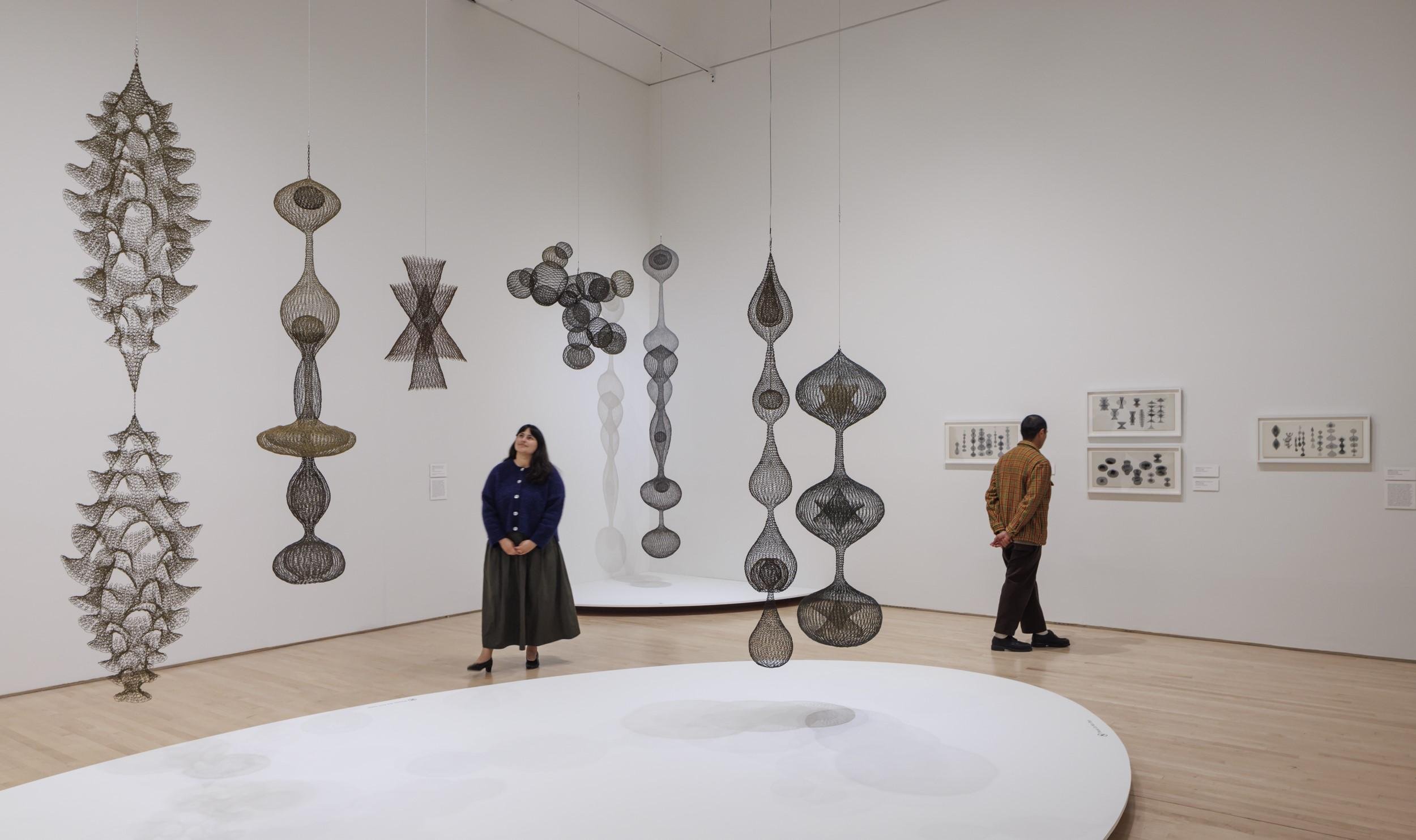
Installation view of Ruth Asawa: Retrospective at the San Francisco Museum of Modern Art, 2025. Photograph: Henrik Kam. Artwork © Ruth Asawa Lanier, Inc., courtesy David Zwirner.
When Museums Rewrite Art History
Institutional recognition can be particularly consequential when it challenges established historical narratives.
The case of Hilma af Klint illustrates this process.
For much of the twentieth century, the Swedish artist's pioneering abstract paintings remained relatively unfamiliar to international audiences.
Her work complicated established accounts of modern abstraction, particularly those centred on better-known figures such as Wassily Kandinsky, Piet Mondrian and Kazimir Malevich.
The Solomon R. Guggenheim Museum's exhibition Hilma af Klint: Paintings for the Future, presented from October 2018 to April 2019, became a significant moment in the wider reassessment of her achievement.
The exhibition attracted more than 600,000 visitors before its final weekend, establishing a museum attendance record at the time.
Its importance extended beyond popularity.
By presenting af Klint's paintings within a major international institution, the exhibition encouraged audiences to reconsider the chronology and intellectual foundations of abstraction.
Yet her example also reveals the limits of conventional market analysis.
Much of af Klint's most significant work is held within foundation structures rather than regularly appearing in commercial auctions.
Consequently, the exhibition's cultural impact cannot be adequately measured through public resale prices.
This distinction demonstrates that institutional recognition and auction-market value are related but separate forms of significance.
An artist can acquire extraordinary historical importance without producing a correspondingly extensive secondary market.
Indeed, limited commercial availability may make the conventional measurement of market appreciation particularly difficult.
Does a Museum Exhibition Actually Increase Prices?
The assumption that major museum exhibitions produce immediate financial benefits has become deeply embedded in collecting culture.
Dealers may refer to forthcoming retrospectives when discussing valuations, while collectors sometimes attempt to acquire works before an anticipated increase in demand.
However, empirical evidence suggests that the relationship is far from uniform.
A 2018 analysis published by Sotheby's examined auction returns for artists before and after major museum exhibitions.
For Impressionist and Modern artists, average annualised repeat-sale returns declined from 8.1% before exhibitions to 6.3% afterwards.
Contemporary artists showed a modest increase, from 11.4% to 12.1%.
The analysis also identified differences between retrospective and thematic exhibitions, suggesting that the structure and historical context of a museum programme can influence subsequent market performance.
These findings challenge the assumption that institutional recognition automatically raises prices.
The underlying research was conducted by an auction-market participant and should be interpreted with that context in mind. Nevertheless, it offers a useful corrective to overly simplified claims about museum-driven appreciation.
Other academic research has identified positive relationships between historical exhibitions and later auction outcomes.
A 2016 study published in Research in Economics found that paintings associated with years in which their artists participated in important historical exhibitions subsequently commanded higher auction prices.
The researchers suggested that exhibition participation could reflect both existing artistic prominence and the lasting reputational advantages generated by institutional exposure.
These findings are not necessarily contradictory.
Museums may help reinforce artistic reputations over extended periods without generating immediate, measurable price increases after every exhibition.
The challenge is distinguishing the influence of institutional recognition from the qualities that made an artist attractive to museums in the first place.
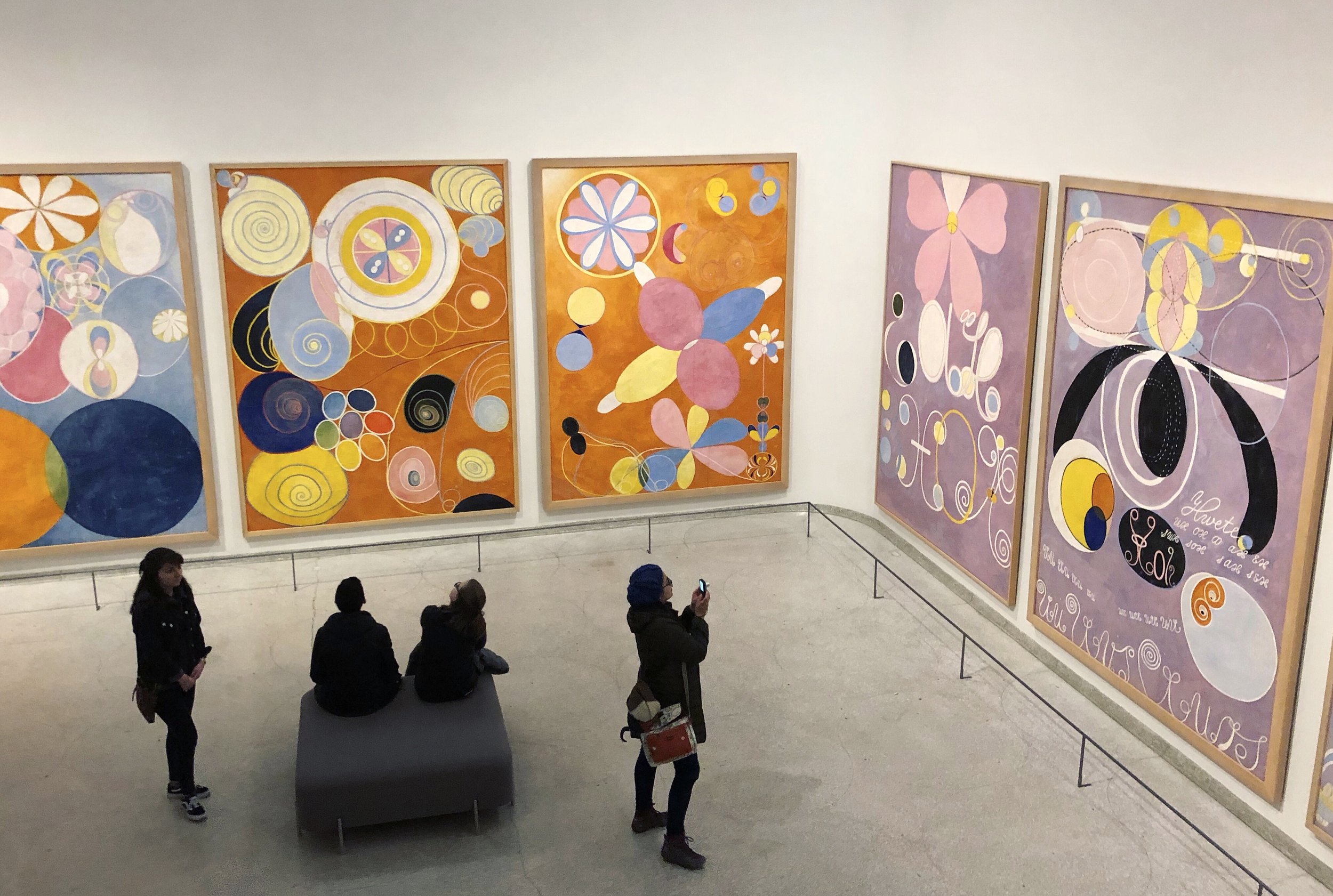
Hilma af Klint's The Ten Largest exhibited at the Solomon R. Guggenheim Museum, New York, in 2018, during the landmark exhibition Paintings for the Future.
Museum Acquisitions and the Economics of Validation
Permanent collection acquisitions can provide a more enduring form of recognition than temporary exhibitions.
An artwork entering a major museum becomes part of an institutional framework intended to preserve and interpret cultural objects over time.
For living artists, such acquisitions may influence future exhibition opportunities, scholarly interest and collector confidence.
They can also affect gallery strategies.
A dealer may seek placements in significant museums because institutional ownership offers visibility and credibility that an ordinary commercial transaction cannot guarantee.
Nevertheless, the acquisition process deserves careful interpretation.
Museums obtain artworks through purchases, donations, promised gifts and other arrangements.
A work entering a collection through a philanthropic gift is not equivalent to a museum independently purchasing it at a negotiated market price.
Both may contribute to cultural recognition, but their commercial significance differs.
Institutional policies also demonstrate that acquisitions involve considerations beyond immediate financial value.
The Walters Art Museum, for example, identifies artistic quality, historical significance, educational relevance, condition and the institution's capacity to care for an object among its acquisition criteria.
These considerations illustrate why museums should not be understood simply as market validators.
An institution may acquire an artwork because it fills an important historical gap, contributes to research or represents a previously underrepresented artistic practice.
Its acquisition need not imply a judgement that the work will appreciate financially.
The strongest institutional recognition emerges when acquisitions are accompanied by sustained scholarship and engagement across multiple independent organisations.
Provenance, Exhibition History and the Confidence of Buyers
Institutional recognition can also influence market confidence through the documentation surrounding individual artworks.
Here, an important distinction must be maintained between provenance and exhibition history.
Provenance refers to an artwork's ownership history, including previous collectors, dealers and transfers.
Exhibition history records where and when the work has been displayed.
Although these forms of documentation are related, they are not interchangeable.
A painting exhibited at the Museum of Modern Art has not necessarily belonged to that institution. It may have been borrowed from a private collection.
Similarly, an artwork formerly owned by a museum may possess a distinguished ownership history, but that history does not automatically establish superior artistic quality.
Nevertheless, documentation can materially influence market confidence.
A 2026 Princeton University thesis examining fine art auction transactions between 1986 and 2025 found that institutional markers, including recorded provenance, exhibition history and literature references, were strongly associated with higher auction prices.
The research also identified relationships between documentation and the probability that an offered artwork would sell.
These findings are valuable, although the study's academic status and observational methodology mean its conclusions should not be treated as universally established causal effects.
The underlying economic principle is straightforward.
Reliable documentation reduces uncertainty.
It can help establish authenticity, clarify ownership, connect an artwork to significant exhibitions and demonstrate the extent of scholarly attention.
Museums contribute to this process through catalogues, conservation records, archival research and publicly accessible collection information.
The J. Paul Getty Museum, for example, publishes provenance research and incorporates new findings into its collection records.
Such practices have importance extending beyond financial valuation.
They contribute to the responsible stewardship of cultural objects and can help identify problematic ownership histories.
Institutional recognition is therefore most valuable when accompanied by rigorous documentation rather than prestige alone.
The Limits of Institutional Authority
The relationship between museums and the market also creates questions concerning independence.
Museums frequently depend on private donors, collectors and trustees whose financial interests may overlap with commercial art markets.
A collector supporting an exhibition may own important works by the featured artist.
Such arrangements do not necessarily indicate improper influence. Private philanthropy has long supported museum programming and acquisitions.
Nevertheless, the potential for conflicts of interest requires transparent governance.
If exhibitions are interpreted primarily as endorsements of commercial value, museums risk being treated as instruments of market promotion.
Institutional independence also matters for artists who remain outside established collecting networks.
Museums can challenge historical exclusions, but they may also reproduce existing patterns of prestige by repeatedly presenting artists already supported by powerful commercial galleries.
The most consequential curatorial decisions are not always those that confirm widely recognised reputations.
They may instead involve sustained engagement with artists whose contributions have received insufficient attention.
The ability of museums to produce meaningful cultural reassessment depends on scholarly autonomy and a willingness to question prevailing market hierarchies.

Tate Modern, London, where museum collections, exhibitions and curatorial scholarship contribute to the long-term recognition of modern and contemporary artists.
Recognition Beyond an Artist's Lifetime
Institutional influence continues after an artist's death.
Retrospectives, archival exhibitions and catalogue raisonnés can reshape the understanding of an established career while introducing neglected works to new generations.
The management of estates and foundations also affects the availability, documentation and interpretation of artworks.
A study published in the Journal of Cultural Economics in 2025, appearing in the journal's 2026 volume, examined more than 22,000 exhibitions and 30,000 auction transactions involving approximately 1,000 artists.
The researchers found that exhibition activity often declined temporarily following an artist's death, while auction prices could experience a significant posthumous premium.
These effects varied according to the artist's previous reputation and circumstances.
The findings demonstrate that cultural recognition and financial value can continue evolving after artistic production has ceased.
Scarcity may influence prices, while institutional programming affects how an artist's legacy is understood.
However, museums cannot guarantee that historical interest will remain constant.
Reputations are continually reconsidered as scholarship develops and cultural priorities change.
The enduring significance of an artistic career depends partly on whether the work continues to generate intellectual engagement beyond the conditions that originally established its reputation.
Conclusion: Recognition Is Not the Same as Value
Museums exercise considerable influence over artistic careers because they help determine which works receive sustained attention, scholarly interpretation and preservation.
Their exhibitions can expand audiences, their acquisitions can strengthen reputational confidence and their research programmes can produce the documentation through which artworks are evaluated.
These processes carry genuine economic consequences.
Yet the relationship between institutional recognition and market value should not be reduced to the assumption that prestigious exhibitions guarantee financial appreciation.
Prices remain influenced by scarcity, quality, provenance, collector demand and broader economic conditions.
The most important contribution of a museum may therefore be something less immediately measurable than an auction record.
Institutional recognition can establish the intellectual foundations through which artistic significance is reconsidered across generations.
For collectors, the distinction between temporary commercial attention and sustained institutional engagement is essential.
For artists, museum recognition can provide opportunities that extend beyond financial success, connecting their work to wider historical and cultural narratives.
Ultimately, the museum effect is most meaningful when an institution does more than increase visibility. It creates the conditions in which an artist's work can continue to be understood, questioned and valued long after the immediate market has moved elsewhere.