Interview with Ramón Rivas

Introduction
Ramón Rivas was born in the land where Miguel de Cervantes set the adventures of Don Quixote (La Mancha, Spain). Therefore, his roots are deeply embedded in a land rich in literary and artistic heritage. His family environment and the multidisciplinary influence of his professional activity—in sports, music, engineering, inventions, and art, in Castilla-La Mancha and Madrid—were decisive in the creation of a highly personal and distinctive artistic style called Rivismo, based on the application of the Experiential Brushstroke. Since 2005, his research has reinforced the concepts and philosophy that predominate in Rivismo, giving prominence to material elements to which he has assigned human aspects, functions, and values. In his personal style, he uses the "Mixed Media-Rivismo" method.
Applying her personal style, she aims to express herself in ways never before seen, challenging established norms, promoting critical reflection, and using pedagogy to democratize access to knowledge and encourage viewer participation in the creative process.
In her compositions, based on creativity, imagination, and innovation, she pays special attention to aesthetics, as this serves as a way to attract the viewer, sparking their interest and guiding them through the artwork. This leads to a state of concentration that allows them to create their own narrative and invites reflection, dialogue, and action.
Prestigious professionals have recognized the exceptional originality and aesthetic appeal of her work, offering their valuable opinions:
“The art of Ramón Rivas is not merely a visual feast; it is a revolutionary act, a space where the imagination is unleashed and the spirits of both creator and viewer merge in a dance of vibrant creativity.
His unique vision and exceptional skills have not only captivated audiences around the world, but have also made significant contributions.
He demonstrates mastery of linguistic plurality, developing his own unique language. In his works, he invites the viewer to participate and feel like a co-creator. As an avant-garde artist, his influence is indelible. His contributions transcend the aesthetic; they are milestones in the evolution of the art world.
His remarkable contributions not only elevate the art world but also establish him as a true pioneer in the global art community. In recognizing his profound impact, we celebrate not only the artist but the pioneer, a visionary who sculpted the future of artistic expression. His work reflects a timeless genius, an unmistakable legacy, and the power to shape art and culture for all.”
His talent has been recognized through international museums, art fairs, and exhibitions. Ramón Rivas's artistic contributions have also appeared in numerous books, magazines, catalogs, interviews, and reviews of his work, solidifying his presence in the contemporary art world. Furthermore, his exceptional talent has been honored with prestigious international awards, further cementing his reputation as a distinguished artist.
Throughout this interview, you will learn more about Ramón Rivas's work and his personal artistic project, Rivismo, whose philosophy and concepts are protected by intellectual property rights. The opinions and evaluations made by the aforementioned art professionals are complemented by a selection of my works that will help you better understand my artistic proposal.
Your artistic language, Rivismo, emerged from an unusually broad professional background spanning engineering, invention, sport, music, design, and communication. Could you describe the moment when you realized these disciplines were not separate influences but components of a single artistic philosophy, and how they continue to shape your work today?
The artistic atmosphere that surrounded me from childhood served as a source to nourish and consolidate the knowledge I gradually acquired from the teachings and practices within my family environment. My grandfather painted murals, my mother landscapes and children's themes, and my father worked with applied techniques that bordered on the artistic. The work I did at my father's company provided me with knowledge of materials, their textures, and the changes they underwent due to the passage of time, deterioration, and the relationships between materials that had participated in joint transformations.
This knowledge led me to believe that materials are alive and that they experience events that could be used to tell stories, through what I later called Experiential Brushstrokes.
After this initial stage, my professional career expanded naturally: organizational engineering, strategic planning and projects, patented inventions (in energy, security, and communication), sports (as a national tennis coach, with involvement in Davis Cup and Fed Cup committees), music (creator and singer of a themed album), and design/communication. As I moved through this multidisciplinary phase, I began to notice that all these activities didn't compete with each other, but rather fed off one another along a single axis: experience as raw material.
Engineering logic was not merely technical, but a way of structuring experience; sport provided dynamic balance (strength/weakness, strategy); music, rhythm and emotional empathy; inventions, the transmutation of the ordinary into something novel. All of this materialized on the canvas through Experiential Brushstrokes, which imbued materials (oxides, metals, burnt wood, mathematical formulas like Fibonacci or Gaussian polygons, etc.) with roles, values, and "experiences" comparable to human ones: experiential balance, equality, empathy, reassignment of functions, "from the whole to a part and vice versa".
In 2005, I materialized this lived experience and subsequently registered it with the Intellectual Property Office as Rivismo, my style, technique, and philosophical system. I no longer saw separate disciplines: the canvas became a space where engineering negotiates with artistic intuition, lived experience, and material elements, not seeking a forced resolution, but a living dialogue.
Currently, I still consider Rivismo not a static style, but a living and evolving system. It continues to organically integrate all those disciplines that shape my work:
-Engineering and invention: These provide the structural architecture, methodical planning, and experimentation with materials (steel, oxides, organic elements, digital prints). I treat the canvas as a project where nothing is accidental: each element has a function and a "voice."
-Sports: This influences concepts of dynamic balance, strength/weakness, and strategy, creating compositions that invite the viewer to visually "move."
-Music: This contributes rhythm, harmony, and experiential empathy; sometimes I incorporate direct references or visually translated melodic structures.
-Design and communication: I strive for the works to surprise, move, and engage the public, democratizing access and transforming the observer into an active participant.
The application of the philosophy and concepts from all this lived and shared information, combined with my own experiences and the experiences of material elements, keeps my work in constant transformation, always seeking to surprise and connect.
Your work reveals an intriguing dialogue between methodical precision and unrestricted imagination. On one hand, your compositions are carefully structured and balanced, while on the other, they seek to surprise, provoke, and encourage creative participation. How do these seemingly opposing forces coexist within your artistic process, and where do you find the balance between control and spontaneity?
Bearing in mind the expression "unity is strength," this term can also be conceptually applied to Rivismo, such that these forces not only coexist but also nourish each other as parts of the same living system. Methodical precision provides the structure that allows the imagination to expand without dissolving into chaos, while spontaneity injects vitality and surprise into that structure, preventing it from becoming rigid or predictable. It is a constant, almost dialectical dialogue, where control does not stifle freedom but rather channels it. The control is backed by my training as an engineer; specialist in organization and strategic planning. Each work stems from a clear philosophical concept and a plan that assigns almost human roles and functions to the materials. Spontaneity enters the scene during execution, especially with the application of Experiential Brushstrokes.
Rivismo seeks the point where the work breathes: ordered enough to communicate, free enough to surprise and remain alive after completion. At this moment, the materials, which have “lived” their own history, find their “voice” and become part of the composition.
Synthesizing these thoughts, my contribution to Rivismo is that control should not stifle imagination: it makes it possible on a grand scale. And that imagination should not destroy order: it enriches and humanizes it. They are two sides of the same experiential brushstroke. This coexistence, reinforced by the spontaneity that gives it soul, is precisely what makes a work of Rivismo not just something to be looked at, but something that continues to happen within the viewer.
You describe your paintings as "walkable spaces" that invite viewers to travel through them and become creative participants themselves. How do you compose a painting to choreograph this visual journey, and what role does the viewer ultimately play in completing the work?
One of the most creative contributions of Rivismo is the establishment of a "traversable space" in whose compositions experiential scenarios are created that the viewer not only observes but also physically and mentally explores, activating their own creativity. The philosophy that the artist Ramón Rivas incorporates when creating the Experiential Brushstrokes imbues the working surface with concepts that give life to the materials and humanize them. The equality and experiential balance between materials, his experiential empathy, the application of the concepts of "the strong and the weak," "from part to whole," and "from whole to part," transform the canvas, preferably large-format, into an experiential habitat that the viewer can explore visually and conceptually, becoming a co-creator.
The visual journey requires choreography, and its composition faithfully reflects the philosophy and concepts of Rivismo and the applied technique of “Mixed Media-Rivismo”. The process combines engineering and intuition. The elements involved in this choreography include:
- A large format, engineering, and spatial architecture. The viewer walks through the painting, discovering details that change according to the angle, distance, and movement.
- The application of experiential brushstrokes attributed to materials, organic/inorganic elements, and scientific, mathematical, or energetic concepts.
- The incorporation of the concepts of balance, equality, and material empathy. Human roles are reassigned to the elements. A balance is sought between forms, colors, light, and energy, with influences from engineering, science, and the observation of life. The composition is ordered and methodical, yet vibrant.
- The use of color, light, and energy. The intense colors and the management of light create emotion, surprise, and positivity.
The viewer is not a passive observer, but an essential creative participant. By moving through the accessible space, they activate the artwork: their personal associations, emotions, and memories complete the open narratives. The Experiential Brushstrokes project energy that envelops the viewer, generating empathy, surprise, unease, or joy. Although the artist prepares the accessible space and imbues the work with energy, memories, feelings, and narrative potential, the work is not complete until the observer has actively explored the space.
In this way, Ramón Rivas transforms the observer into a “creative artist” during the experience, merging imagination and aesthetic sensibility. As a result of this complicity between artist and viewer, the latter becomes an essential co-creator and the one who brings the work to fruition.
Since 2005, your research into Rivismo has focused on what you call "Experiential Brushstrokes" and on assigning human qualities and values to material elements. Could you elaborate on the philosophical foundations of this idea and explain how these concepts are translated into the physical language of paint and mixed media?
The philosophical foundations of Rivismo center on "Experiential Brushstrokes" as carriers of the lived experiences of materials, objects, elements, and devices (in their relationship with people), along with the attribution of human qualities, values, and empathy to these material elements to achieve equality, balance, and a reassignment of roles.
The materials (rusted sheets, engine or vehicle parts, stones, wood, food, threads, bubbles, etc.) cease to be mere passive supports or "silent witnesses" and acquire a "voice" in the work: they are attributed with feelings, empathy, active roles, and the capacity to transmit energy, memories, mystery, emotion, or reflection to the observer.
Main Philosophical Foundations
Experiential Equality and Balance Between Strength and Weakness:
Traditional hierarchies are redefined. “Strong” elements (steel, iron, stone) exchange or cede functionality to “weak/fragile” elements (thread, paper, soap bubbles, egg, fabric, plastic, food) and vice versa. Conceptual examples: cracks in steel sheets “repaired” with needle and thread; a fried egg that transforms into a gear and assumes its function; soap bubbles that cover motors or steel sheets. This generates energetic balance and challenges discriminations of power or prominence.
Reassignment of Roles and Empathy Among Materials:
Elements are endowed with human qualities (suffering, resistance, heartbeat, communication). Concepts such as “Faces of Matter” or “Experiential Masks” channel these feelings. A part of a motor or a sheet of metal can become a face or figure that expresses experiences.
From Part to Whole and from Whole to Part:
A fragment (a section of an engine cylinders, for example) can function as an autonomous whole, and a complete composition can reappear as a part within itself or another. This generates experiential mosaics, material faces, superimpositions, and energy flows.
Molecular/Energetic Charge and Transmission:
The brushstrokes “molecularly charge” the canvas with thousands of experiences. The artwork becomes a circuit of energy transfers that evokes memories, associations, unease, surprise, or joy in the viewer. It is based on the observation of interrelational flows between materials, organic/inorganic matter, and people, influenced by the artist's multidisciplinary background. There are allusions to ideas such as relativity or additional dimensions for N-dimensional or multi-temporal brushstrokes.
Translation into the physical language of painting and the mixed media technique used:
These ideas are materialized through a technique exclusive to Rivismo, called Mixed Media-Rivismo, which prioritizes the real or represented incorporation of materials with history over the traditional pictorial brushstroke:
Substitution or integration of pictorial matter:
Instead of (or in addition to) applying paint with a brush or palette knife, fragments or representations of real materials (rusted sheet metal, mechanical parts, wood, stones, organic elements) are integrated, their textures, colors, oxides, wear, and traces becoming the “brushstrokes.” Digital technology and other techniques are used to capture and incorporate these experiences. Conventional painting, when it appears, is subordinate.
Compositional construction:
Superposition of simple or complex experiential brushstrokes. Incorporation of three-dimensional elements. Use of textures and living layers. Creation of energetic currents. Application of practical reassignment among materials.
The physical limit of the frame is transcended: the composition continues in the mind of the observer, and the frames themselves can also be incorporated as experiential brushstrokes.
Textures, colors, light, and supports: These are derived directly from the original elements (fireplace embers, rust, weathered machinery paint, etc.). A variety of supports are used: canvas, wood, steel, iron, aluminum, fabric, paper, stone, plastic, video, and others. Works may include human parts (eyes, mouth) combined with materials to maximize shared empathy.
Explanatory examples: In pieces like The Egg's Scream (2006), the "experience" of an egg in a pan is visualized (the escaping white, the yolk transformed into a suffering face). In Experiential Entrapment, strong and fragile materials are combined with joints and gaps that materialize the exchange of energy and equality. Figures or faces are constructed from engine parts or sheet metal ("From a Part to the Whole").
The result is a visual, colorful, and creative work that is not only viewed but also "read" through the stories and energies deposited in each material element. It is an artistic creation that seeks to bring freshness to 21st-century contemporary art by giving true freedom to the elements, as if they were participants in a human relationship. Research since 2005 has developed and presented these concepts in diverse formats and contexts, always prioritizing pedagogy and accessibility.
Growing up in Ciudad Real, the landscape of Don Quixote, while also being surrounded by generations of artists and artisans seems to have given you two distinct inheritances: literary imagination and craftsmanship. In what ways do these cultural and familial legacies continue to resonate in your visual vocabulary?
Although the consolidation of my personal work system, Rivismo, came after the continuous influence of my experiences and work within the artistic family environment of my early life, I can affirm that the influence of Don Quixote was present from that stage, as I witnessed my family members creating artwork related to Don Quixote's exploits.
Regarding my own work during this phase, I also handcrafted several pieces featuring Don Quixote, Sancho Panza, and a windmill, using iron, wood, leather, and industrial paint. Furthermore, my mother, who was both a painter and a teacher, ensured that this literary work, considered the most widely read/sold novel in the world, remained present in our family.
Analyzing Don Quixote's qualities, the concept of Quixotism emerges, whose most important traits are: radical idealism; unwavering faith and courage; boundless imagination and the ability to transform reality; kindness and moral nobility; individual freedom and rebellion against the established order; melancholy and intermittent lucidity; and human contradiction, combining spiritual grandeur with outward absurdity, which makes him profoundly human.
All these qualities have fostered the pursuit of noble ideals, even when they seem impossible or absurd in the face of pragmatic reality.
Regarding Rivismo, which is based on the "Experiential Brushstroke," where the organic and inorganic material elements of the composition (textures, colors, forms, devices, expressions, etc.) are imbued with human values, functions, and aspects, creating a union between the material and the spiritual, between the artist and the viewer, its creator, Ramón Rivas, has established a connection between his artistic proposal and the figure of Don Quixote:
- He has created several works directly inspired by the character, such as Experiential Visions of Don Quixote, Manchegan Magnetism (a tribute to the Manchegan knight), Revelation Among Containers and Flowers, and other pieces that represent him.
- He considers Don Quixote a powerful symbol of his homeland and of values that resonate with Rivism: the ability to transform ordinary reality (matter) through the force of inner experience, imagination, and will.
- The "magnetism" he mentions in titles like Manchegan Magnetism may allude to that irresistible attraction of Quixotic ideals, similar to how Rivism seeks for pictorial matter to "attract" or express profound human experiences.
- The artist sees in Don Quixote a precursor or parallel to his philosophy: someone who imposes his inner vision on the material world, endowing it with higher meaning, in a way similar to how Ramón Rivas assigns human qualities to pictorial elements.
In short, while Don Quixote's qualities belong to the literary and philosophical realm (idealism, courage, nobility, transformative imagination), Rivismo takes them, in part, as visual and conceptual inspiration for its artistic language: an attempt to make organic and inorganic matter "live" intense human experiences, just as the knight from La Mancha gave epic life to the prosaic.
These cultural and familial legacies resonate deeply and structurally in Rivismo, fusing Quixotic imagination with a craftsmanship that breathes life into materials and elements, thus enhancing its visual language. In summary, the triangle formed by Ramón Rivas, Rivismo, and Don Quixote—in which the land of La Mancha, transformative imagination, and the revaluation of matter through experience—contribute to creating the "factory" whose final "product" brings novelty and freshness to contemporary art.
Mixed media appears to be more than a technical choice in your practice. It seems to function as a conceptual framework for integrating diverse experiences and disciplines. How do you decide which materials belong in a particular work, and what expressive possibilities do they offer that a single medium cannot?
In the case of Rivismo, the technique used, Mixed Media-Rivismo, is not a generic mixed media technique, but rather the concrete and documented application of the Rivismo philosophy through the superimposition of real materials imbued with “experience,” concepts of equality/empathy/strong-weak, and a hybrid (analog + digital) execution that seeks to generate a living, participatory, and constantly evolving art. According to the editor of World of Art, this technique is a testament to the transformative power of art in the digital age. Its visionary synthesis of geometry, symbolism, and emotion redefines the limits of mixed media, positioning Rivismo as a philosophical and aesthetic movement that bridges science and spirituality, technology and humanity. In Rivas's universe, each cube, sphere, and crystalline structure is a metaphor for consciousness, a reminder that art, like infinity, is not a destination, but an experience.
According to Ramón Rivas himself, the canvas becomes a space of negotiation between:
- Engineering logic (technical, constructive, and organizational).
- Artistic intuition.
- Lived experience (the “experiential brushstrokes”).
This does not seek to “solve” a technical problem, but rather to generate a living, participatory, and evolving artistic system. The Mixed Media-Rivismo technique is precisely the result of this hybridization: layers of real materials (metals, oxides, organic materials, digital materials) organized with project rigor but imbued with experiential meaning.
The choice of materials does not stem primarily from conventional aesthetic criteria (color, texture, or durability), but from the experiential and conceptual weight that each element contributes, and which fulfills the philosophy and concepts of Rivismo, as required in the application of the following concepts:
- Lived experiences and material memory: Materials or objects that have coexisted with humans or other elements are selected, recording wear, histories, interactions, or transformations so that they act as protagonists.
- Experiential balance and quality: Combinations are chosen that allow for the confrontation and balance of opposites (strong/weak, organic/inorganic, rigid/fragile). The reassignment of roles is key: the weak assumes the functions of the strong and vice versa, creating balance and empathy.
- The capacity to generate faces, masks, and narratives: Materials that can be transmuted into “faces of matter” or “experiential masks” to channel feelings and energies. This allows parts to represent the whole (and vice versa), creating intra-empathy or emotional associations.
- The author's multidisciplinary influence: The decision is informed by Rivas's experiences in engineering, sports, music, and the observation of interrelational flows. The materials must serve the pedagogical concept of Rivismo: to evoke memories, emotions, surprise, or reflection in the viewer regarding matter and human life.
Regarding the expressive possibilities that a single medium cannot offer, mixed media techniques in Rivismo greatly expand artistic language because they integrate dimensions that traditional painting or sculpture cannot achieve on their own:
- Experiential dimension and molecular narrative: A single medium (oil, acrylic) primarily conveys the artist's gesture and the properties of the pigment. Experiential brushstrokes incorporate real histories of the materials, creating an "energetic charge" that evokes shared experiences, empathy, and transmutation. This generates temporal and relational depth.
- Dynamic balance and redefinition of roles: It allows for confrontations (strong vs. weak) and visual/conceptual resolutions impossible in a homogeneous medium. It creates tension, surprise, and harmony through real material contrasts, not just painted ones, such as gears or soap bubbles protecting motors. The reassignment of roles is key: the weak assumes the functions of the strong and vice versa, creating balance and empathy.
- Empathy, voice, and humanization of matter: Materials "come alive" through experiential faces and masks. A single medium can hardly imbue objects with feelings or endow them in such a literal and poetic way. This invites reflection on consumption, obsolescence, sustainability, and human-object relationships.
- Sensory and dimensional multiplicity: It combines real textures, volumes, transparencies, opacities, and even kinetic or installation elements. It offers readings at different scales (from the part to the whole), energetic windows, and superimpositions that enrich the interaction with the viewer.
- Pedagogical and universal character: By being inclusive and based on everyday experiences with common materials, it opens art to all audiences, beyond aesthetic elites. A single medium would tend to be more formal or self-referential.
In short, in Rivismo, mixed media functions as a philosophical and artistic system that transforms the artwork into a living stage of interactions, where the materials do not illustrate an idea, but rather embody the idea through their own experiences. This generates a richer, more empathetic, and multidimensional expression that transcends the limitations of any isolated medium.
The artist acts more as a mediator and facilitator than as the absolute creator, allowing the artwork to become a field of active tensions where the tangible and the conceptual converge. This results in surprising, emotive works with a unique identity, transcending traditional painting toward a living and participatory language.
Scientific ideas, innovation, and invention occupy a central place in your artistic thinking, yet your stated ambition is to surprise and emotionally engage the viewer. How do you approach the relationship between intellectual inquiry and emotional experience so that neither overwhelms the other?
In Rivismo, intellectual inquiry (scientific, innovative, and inventive) and emotional experience are not opposed, but rather integrated in a balanced and mutually enriching way through "Experiential Brushstrokes," the core of his artistic philosophy. Drawing on his multi-professional experiences as an industrial engineer, inventor, musician, and athlete, the artist constructs his works (primarily in mixed media and large format) incorporating not only pigments, but also the lived experiences of materials, objects, organic/inorganic elements, devices, and mathematical, physical, computer, or energetic expressions. These brushstrokes "molecularly charge" the canvas with meanings, energies, and narratives.
Intellectual inquiry is primarily introduced in the following ways:
- Application of concepts such as "From Part to Whole and from Whole to Part," "Experiential Equality," "Empathy between Materials," "Reassignment of Roles," and the balance between "the strong and the weak."
- Influences from science, engineering, innovation, and the rigorous observation of interrelational flows between matter and people.
- Exploration of futuristic, optical, geometric, and symbolic themes (with echoes of Escher or Dalí, but with a technological and contemporary imprint).
With respect to the emotional and sensory dimension, these brushstrokes endow the materials with "voice," "faces," or "experiential masks" to channel feelings. The explicit objective is to surprise and move the viewer, provoking memories, experiences, associations, unease, mystery, emotion, surprise, or joy. The works are immersive and educational: they invite the observer to actively participate, reconstruct narratives, and become a co-creator.
To achieve a balance between intellectual inquiry and emotional experience, ensuring neither predominates over the other, the following concepts are employed:
- Organic Integration: The intellectual structure (precise concepts, technical innovation, compositional rigor) is neither cold nor abstract; it serves as a vehicle for transferring emotional and experiential energy. The "molecular charge" unites the rational (science, mathematics, engineering) with the sensory and affective (empathy, memories, surprise).
- Equality and Redefinition: Concepts such as Experiential Equality and Empathy between materials avoid hierarchies. The intellectual (scientific ideas) and the emotional (human and material experiences) share the same plane, generating harmony rather than dominance.
- Viewer Experience: The works do not merely illustrate ideas; they create "traversable" spaces that stimulate both intellectual contemplation (analysis of patterns, concepts) and an immediate emotional response (immersion, surprise, personal connection). The result is a vibrant, colorful, surprising, and creative work of art that enriches the citizen holistically.
In short, Rivismo addresses this relationship through an experiential synthesis: intellectual inquiry provides the innovative and profound structure, while emotional experience emerges from the "life" imbued in the materials and from the interaction with the viewer. Neither predominates because both merge in the Experiential Brushstrokes, creating an art that is simultaneously rigorous thought and human emotion, thus generating works of great visual and conceptual density that activate the senses, intellect, and feelings in an integrated and surprising way. This reflects the multifaceted trajectory of Ramón Rivas, where science, invention, and art unite to generate a new dimension in contemporary art.
Your career has moved fluidly between leadership roles in international sporting events, advertising, engineering, and the visual arts. Looking back, are there particular principles from those fields, such as movement, strategy, systems thinking, or collaboration, that have fundamentally transformed the way you conceive and construct a painting?
I affirm that there are specific principles from these fields which, as reflected in my own statements and the analysis of my work, have fundamentally transformed my conception and construction of painting within Rivismo.
Rivismo, based on “experiential brushstrokes,” is not only a formal style but a creative system that deliberately and retrospectively integrates multidisciplinary experiences. I have reiterated in interviews that my artistic family background and, above all, my background in engineering, the organization of international sporting events (Davis Cup, Fed Cup), advertising/graphic design, inventions, and visual arts “loaded the files in my brain” and were decisive in giving consistency to this approach.
My training as an industrial engineer specializing in organization and my work in the development of inventions have allowed me to bring this systemic approach and structural precision to the canvas. Rivismo treats pictorial space as an interconnected system where each element (strong materials like steel or iron, weak ones like threads, bubbles, or organic matter) has functional roles that are reassigned. Concepts such as Experiential Equilibrium, Experiential Equality, and the tension between Strong and Weak function as engineering principles applied to composition: action-reaction, balance of forces, and optimization of parts for a coherent whole. It is not about filling the pictorial space intuitively; planning, organization, and precision in execution predominate. Mathematical formulas (Fourier series, Fibonacci sequences, Gaussian polygons, the golden ratio, the equation of Relativity, etc.) are incorporated as structural protagonists, not as mere embellishments. The canvas becomes a “walkable” or immersive space, where macro and micro scales negotiate, similar to how an engineer designs complex systems that integrate disparate components.
My experience in high-level sports (coaching, event organization) has instilled in me dynamism, fluidity, and compositional strategy. Experiential brushstrokes capture flows, energy exchanges, and roles (as in "Organic Transmutation," where a gear transmits "power" to an egg). This generates visual and narrative movement, with a reassignment of functions reminiscent of team or competitive strategies, balancing interacting elements.
From my experiences in the world of advertising and design, I have incorporated into my work the ability to surprise, captivate, and communicate ideas in an impactful and accessible way. I seek innovative proposals that generate emotion, surprise, and associations in the viewer. Rivismo is educational and aimed at all audiences, with a strong narrative and conceptual component (faces of matter, experiential masks). Collaboration is seen in the "empathy between materials" and the integration of diverse elements into a coherent whole, similar to advertising campaigns or creative productions.
These principles merge into a creative process that is both analytical (planning, structure) and intuitive (inner imagination, stored experiences). Rivismo, in the hands of its creator, constructs hybrid realities where industrial materials (iron, copper, chips) interact with organic materials, creating textures, lights, silhouettes, and energies that transcend traditional painting. The result is a multidimensional work that integrates systemic precision, strategic dynamism, and impactful communication. All of this radically transforms the conception of painting, from a mere stroke to a living and balanced experiential ecosystem.
Your work has been exhibited internationally and is held in museum collections across different cultural contexts. Have audiences in Europe, Asia, and the United States responded differently to the participatory and experiential dimensions of Rivismo, and have these encounters influenced the evolution of your practice?
My work has been exhibited internationally (Spain, China, Japan, South Korea, Italy, Denmark, the Netherlands, France, England, Greece, Portugal, the Philippines, the United States, among others) and is part of museum collections in Spain, Denmark, and South Korea. There are records of exhibitions in Shanghai (Wison Art Center, Pudong Library, CEIBS, 2012), Geoje (South Korea), art fairs such as ArtExpo New York and Spectrum Miami, Los Angeles, Chicago, digital displays in Times Square and Big Screen Plaza (New York), Osaka (Japan, 2026), Lisbon, Paris (Montmartre), Venice, Milan, Amsterdam, London, and others.
The available sources (interviews with the artist, art books, catalogs, international awards, official websites, and reviews) highlight a universal appeal and widespread positive reception: the acquisition of global audiences, professional assessments of originality and contribution to contemporary art, and the role of the internet, blogs, and social media in its dissemination. Emphasis is placed on viewer participation (moving from passive observer to protagonist who completes the work with their experiences), the symbiosis in digital/urban formats (especially in New York, with its massive and diverse reach of passersby and tourists), and the democratization of art beyond elitist circuits.
In Asia (China, Korea, Japan), a conceptual affinity is mentioned with East-West dialogues and concepts such as strong/weak or role reassignment. The textural density and active participation appeal due to their affinity with concepts of transformation and coexistence.
Rivismo, with its mix of materials and exploration of perceptions, seems to connect with contemporary Asian sensibilities toward innovation, the harmony between the organic and the mechanical, and immersive experiences. Collections in South Korea and previous exhibitions in Shanghai indicate a positive reception, possibly due to its universal and futuristic character that transcends cultural barriers.
In Europe and the US, Rivismo's presence at fairs, museums, exhibitions, and on public and private screens is similarly well-received, without detailed regional distinctions regarding its participatory or experimental nature. Responses often highlight cultural integration and dialogue with artistic traditions (such as homages to Van Gogh or references to Da Vinci). Large-scale works invite viewers to "journey" through visual narratives, which has generated positive reviews for their intellectual and emotional depth, aligning with an audience that appreciates the historical and artistic context.
The American public, often receptive to participatory, experiential, and multidisciplinary art (influenced by traditions such as Fluxus or immersive installations), values how Rivismo transforms the viewer into a co-creator. The numerous American awards and media coverage underscore an enthusiasm for its technical and philosophical innovation, with an emphasis on emotional accessibility and the "visual journey.".
All these international encounters have clearly influenced the evolution of Rivismo, reinforcing its participatory and universal character. Its trajectory shows continuous development: from early exhibitions in China (2012-2014) to recent participations in Asia, Europe, and the USA, with a greater emphasis on works that foster intercultural dialogue and co-creation. This has consolidated Rivismo as a dynamic, not static, "movement," open to influences and adaptations based on global responses.
In short, although there is no very specific publicly available quantitative data on regional differences, based on information obtained from various media outlets, the public and critical response has been "excellent" wherever it has been exhibited, with positive surprise at the innovative and unique nature of the style.
Over the years, Rivismo has evolved through continuous research and experimentation rather than remaining a fixed style. Looking ahead, which aspects of your philosophy or practice do you feel are still unresolved, and what new artistic challenges or discoveries are you most eager to pursue?
Rivismo, as a living system of creation, remains an open process of constant research and experimentation, not a closed style. As explained in previous answers, its driving force and evolution are based on experiential brushstrokes, experiential equality, empathy between materials, and the balanced tension between strength and weakness, integrating art, science, engineering, and human perception. This allows materials (organic, inorganic, devices, mathematical or physical expressions) to acquire a voice and narrative prominence in the work.
Regarding aspects that are still unresolved or under development, several philosophical and practical core issues remain open fronts: …
- Integrating the scalability of experiential empathy into large-scale immersive environments—such as architectural spaces, urban environments, or multisensory collective experiences—by resolving technical and conceptual challenges.
- Deeper integration with emerging technologies, complementary to those already incorporated into Rivismo, such as generative AI, augmented/virtual reality, biotechnology, and smart materials, among others, but always without losing the humanist and materialist essence of the system based on Experiential Brushstrokes. Their participation would be like an additional support tool.
- The redistribution of power and dignity beyond the canvas: The philosophy seeks to give voice to the “weak” or the silenced (materials, objects, forgotten elements). Extending this to broader social, ecological, or ethical dimensions—for example, in collaborative projects with communities or in response to environmental crises—requires further experimentation. It is not just about representation, but about generating a real impact on collective perception. …
- Measuring and documenting the “experience”: Objectively defining the perceptual and emotional impact of the works remains a challenge. Although there is a strong intuitive and phenomenological basis, more rigorous protocols (perhaps interdisciplinary, incorporating neuroscience or psychology) are lacking to validate and refine the core concepts.
- Organic and energetic transmutation at more complex levels. Concepts such as “From part to whole and from whole to part,” “experiential empathy,” or the mutation between strong/weak work excellently in compositions, and the next step would be to extend them to interactive, living works, or works that evolve over time (incorporating AI in a controlled way, for example).
Regarding new challenges, I can consider some that could enhance the philosophy and concepts of Rivismo: …
- Explore “living” or reactive materials that change with time, light, sound, or human interaction. I envision brushstrokes that literally evolve, recording collective experiences and autonomously generating new narratives. This would further merge art, science, and life.
- Projects that connect works on different continents, where the experiences of some materials travel and are reassigned to others, creating transnational networks of empathy. Rivismo could contribute to rethinking sustainability—not only ecological, but also perceptual and social.
- Move toward works where the viewer not only observes, but is molecularly integrated into the composition (physically or virtually). Discovering new forms of “dynamic equilibrium” between observer, material, and environment would be a major breakthrough.
- Collaborations with fields such as quantum mechanics, neuroscience, or AI ethics to delve deeper into questions such as: Can machines or algorithms generate authentic experiential brushstrokes? How is empathy transferred to non-human entities?
- To ensure continuous international projection (exhibitions, fairs, public displays, publications, museums) and the consolidation of Rivismo as a living contribution to the evolution of contemporary art, always from research and creative freshness. …
In short, my greatest challenge and excitement lies in maintaining Rivismo as a living, participatory, and perpetually evolving language: open to innovation without diluting its core ethical and aesthetic principles of equality, balance, empathy, and role reassignment. The goal is not to close off systems, but to provoke interrelational flows that continue to surprise, excite, and connect the human with the material in an increasingly complex world. The future of Rivismo lies in continuing to experiment, research, and allow materials and experiences to keep redefining their own roles. Continuous research is the driving force; surprise and emotional connection, the objective.
Web page: http://www.rivismo.com/
Blog: https://ramonrivas-rivismo.blogspot.com/
Facebook: https://www.facebook.com/ramonrivismo
Twitter: https://twitter.com/rivismo
Instagram: https://www.instagram.com/ramonrivas_rivismo/
LinkedIn: https://www.linkedin.com/in/ramón-rivas-962487102/
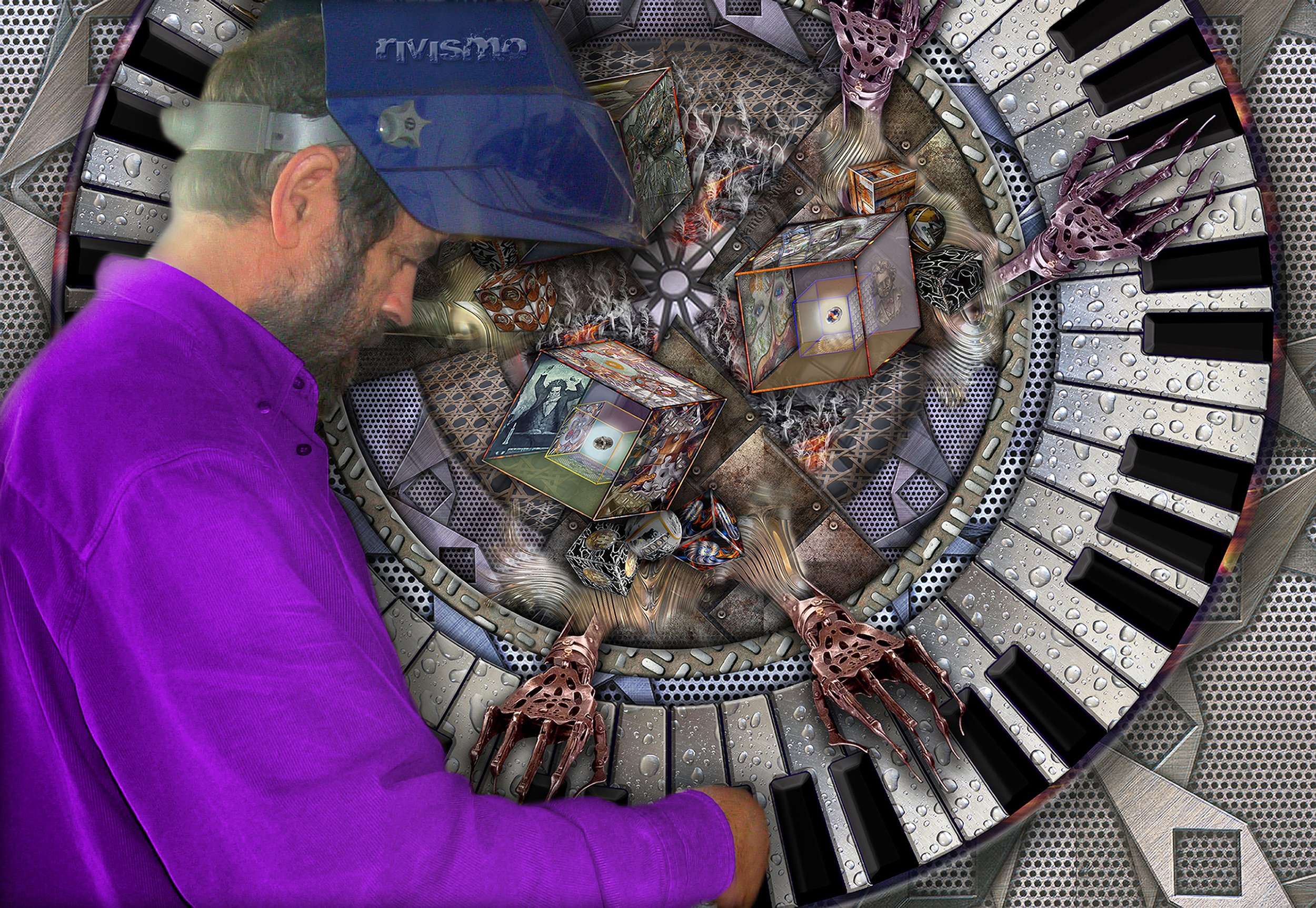

“Exchange and Reassignment of Roles in the Materials” Mixed media-Rivismo 170x195 cm 2026

“Expo-Park of Experiential Art III” Mixed media-Rivismo 182x195 cm 2025
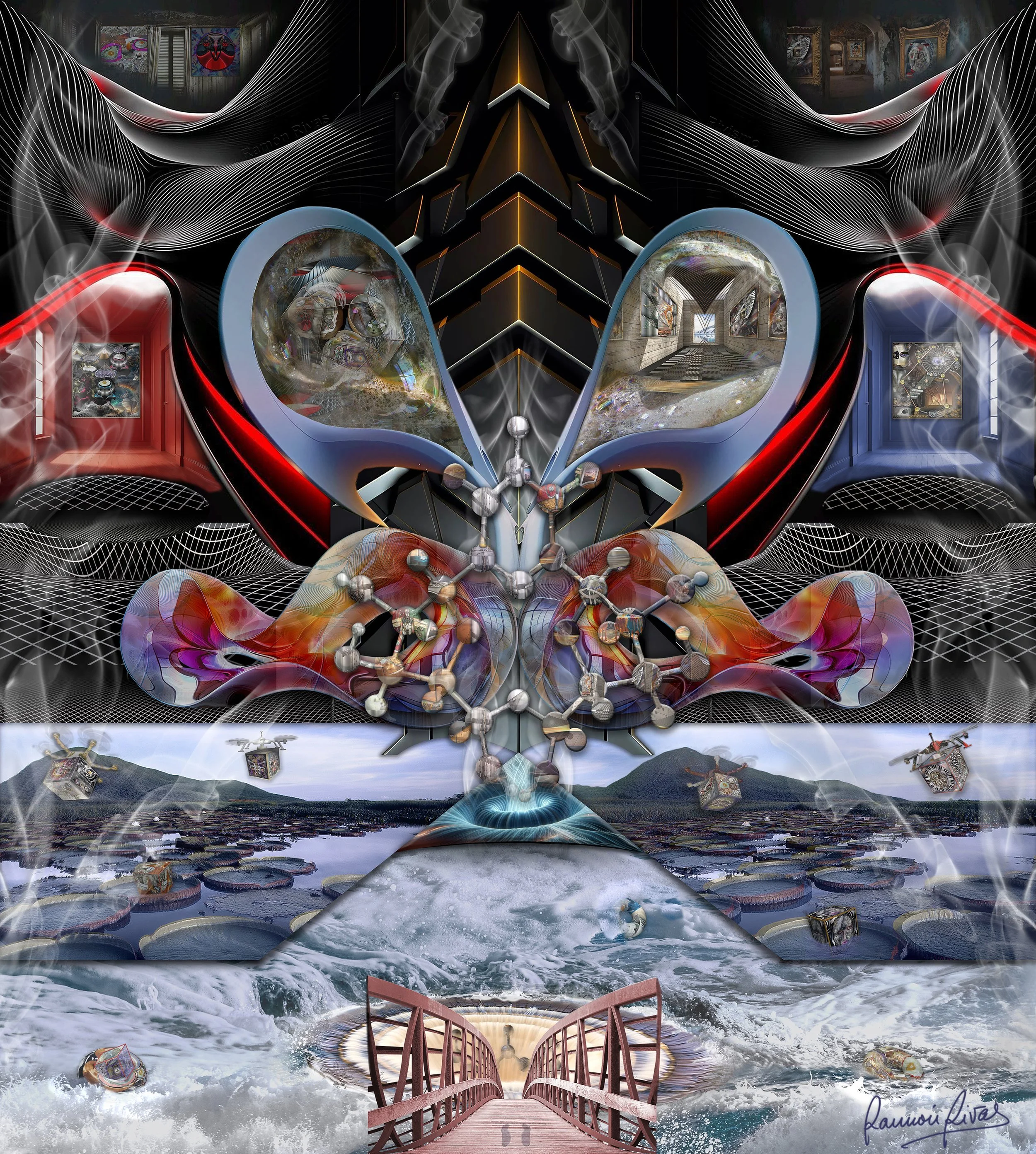
“From Mathematical Infinity to Experiential Infinity” Mixed media-Rivismo 175x195 cm 2026
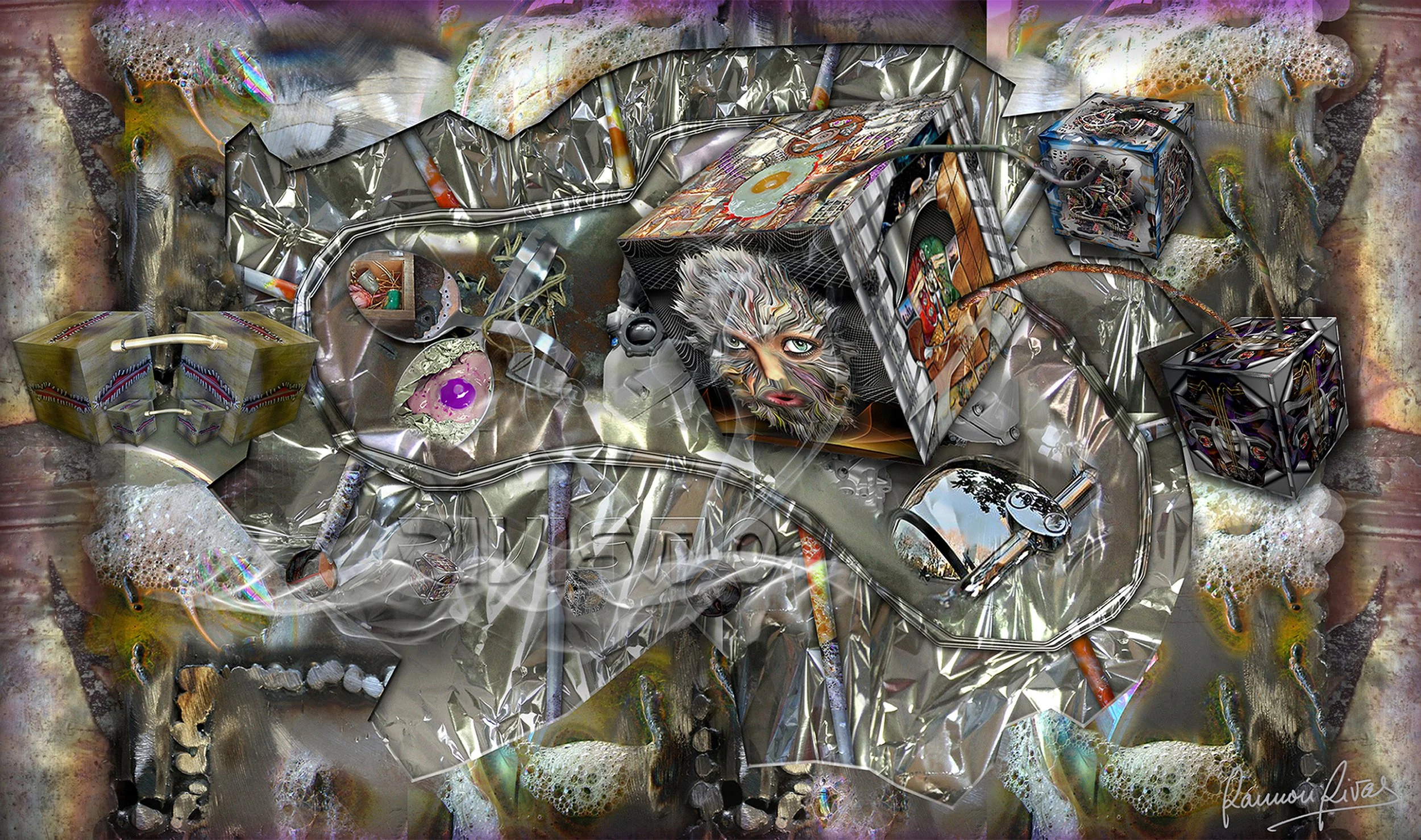
“Experiential Brushstrokes Meeting II” Mixed media-Rivismo 195X114 cm 2026

“Magnetism Manchego. A Tribute to Don Quixote” Mixed media-Rivismo 150x195 cm 2025
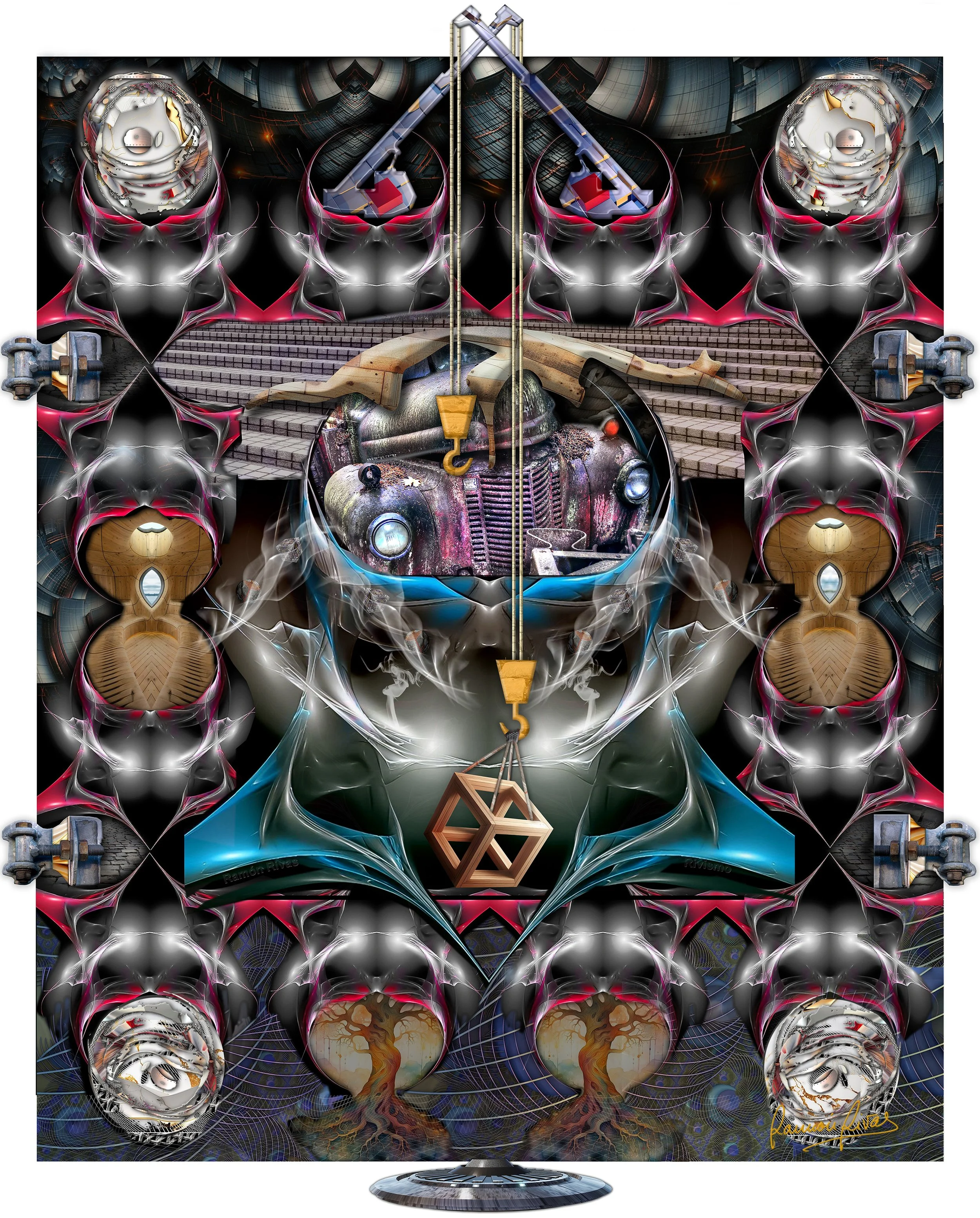
“Bright Flashes in an Experiential Storefront” Mixed media-Rivismo 161x200 cm 2026
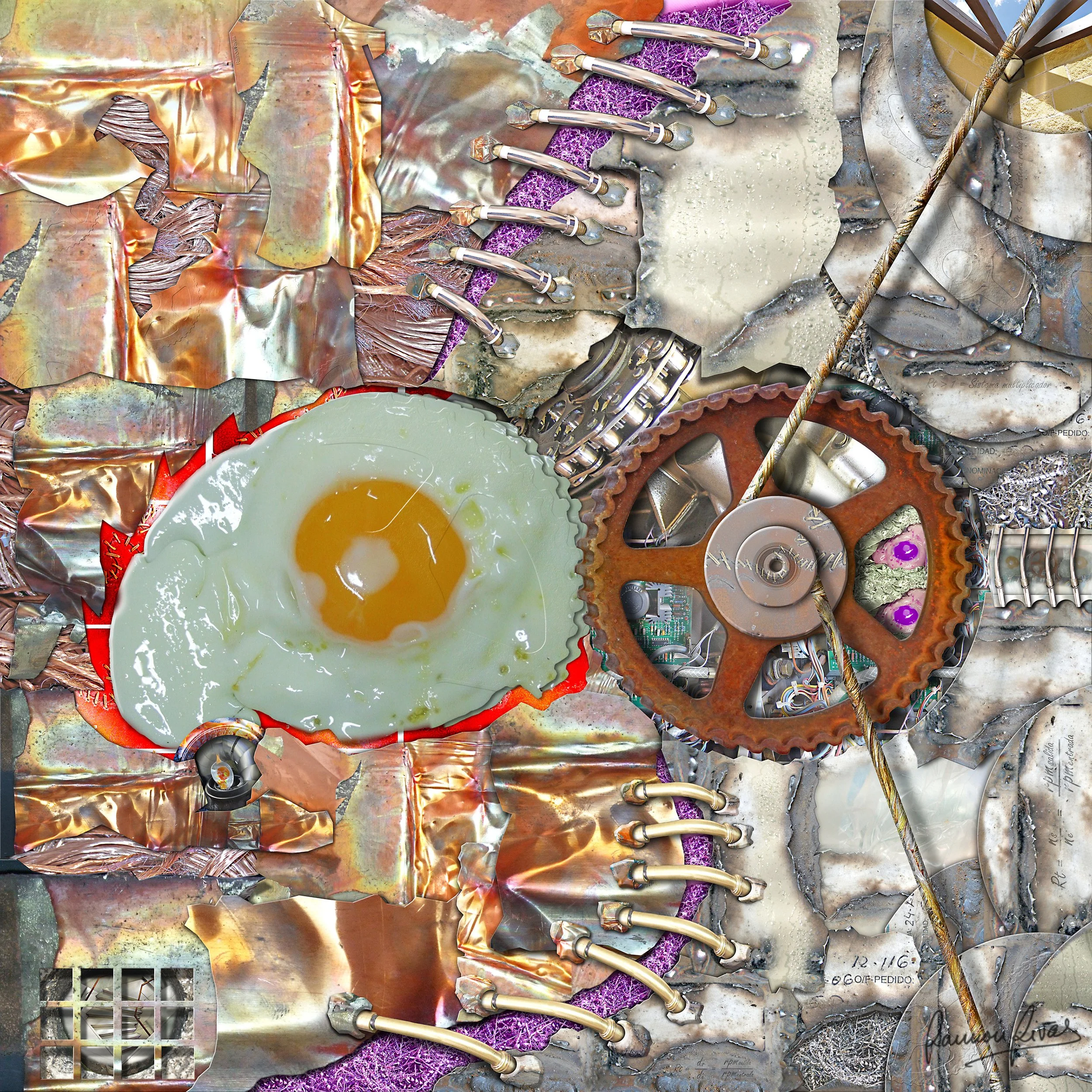
“Organic Transmutation” Mixed media-Rivismo 195x195 cm 2009
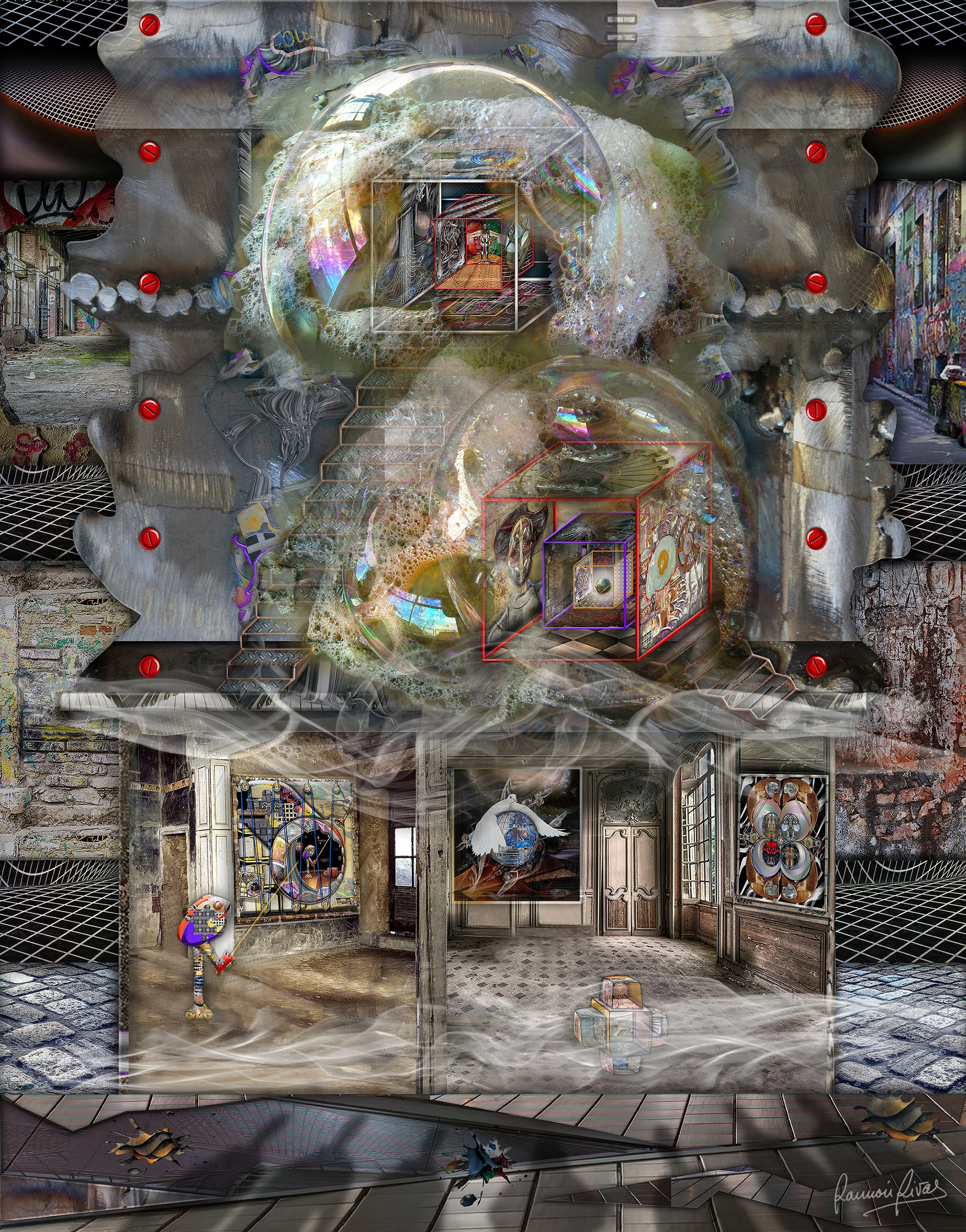
“Art Explosion In-Out II” Mixed media-Rivismo 160x195 cm 2026

“Magic Square between 17-sided Gauss Polygons” Mixed media-Rivismo 195x195 cm 2018
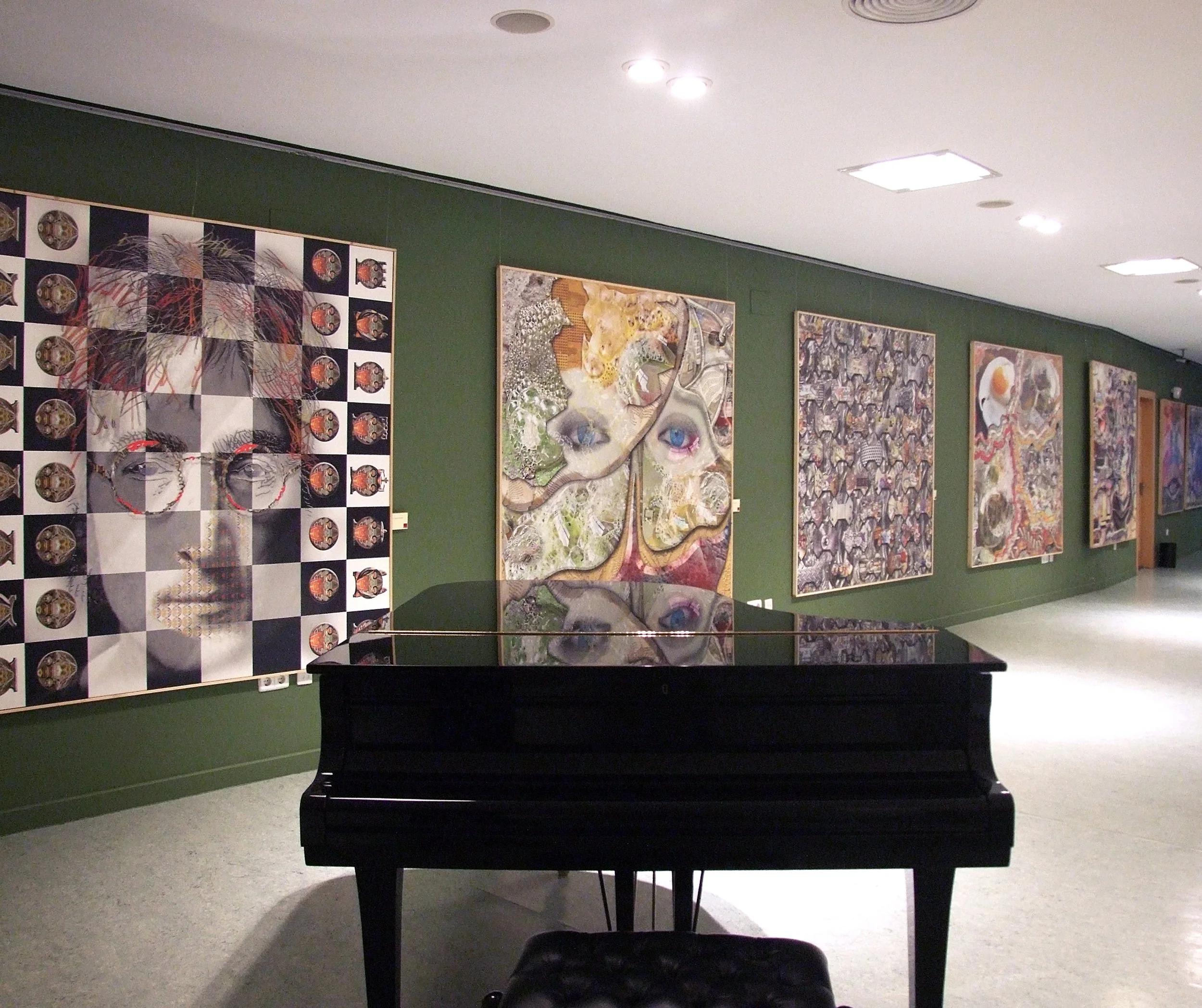
Expo-Ramón Rivas - University of Castilla-La Mancha

Work by Ramón Rivas - Museum in Geoje, South Korea